
Anxiety Coping Skills That Actually Work: A Practical Guide


You're in the middle of it, and the body knows first. The hallway is too loud, the classroom door feels too far away, and a teen can go from "fine" to furious or frozen after one sharp comment, one social setback, or one stressful class. An anxiety coping skill matters only if it works in real life, not just on a calm afternoon at home.
For many teens, the most useful skill is not a motivational phrase. It is a repeatable, body-based tool that still works when stress is high and clear thinking is low. Grounding through the 5-4-3-2-1 method stands out because it gives the nervous system a job, pulls attention out of the spiral, and can be practiced until it feels automatic. It does not deny anxiety. It helps teens stay present long enough to get through the moment.
Table of Contents
Why Teens Need an Anxiety Coping Skill That Works in Real Life
How to Use the 5-4-3-2-1 Grounding Method Step by Step - 1. Name 5 things you can see - 2. Name 4 things you can feel - 3. Name 3 things you can hear - 4. Name 2 things you can smell - 5. Name 1 thing you can taste - Quick version for teens in public
When Teens Can Use 5-4-3-2-1 at School, Home, and Social Events
What to Do When the Skill Does Not Seem to Work - 1. The breathing is too shallow - 2. The pace is too fast - 3. The person gives up too soon - 4. Grounding turns into avoidance
Why Teens Need an Anxiety Coping Skill That Works in Real Life
Teen anxiety rarely shows up at a convenient time. It hits in crowded hallways, before tests, during sports, in the car on the way to school, or in the middle of a hard conversation at home. When anxiety spikes, clear thinking shrinks. That is why a coping skill has to be simple, practical, and easy to remember.
A sophomore between classes may feel a math test sitting like a stone in the chest. The phone is clenched, the breath is shallow, and every sound seems louder than it should be. In that moment, what helps is usually not a clever sentence. It is a body-based action the teen has practiced enough to use without much thought.
Parents often see the same pattern at home. A missed ride, a friendship problem, or one stressful text can tense up the whole room. The instinct is to fix it, explain it, or talk the teen out of the feeling. Usually, the more useful first step is helping the body settle before trying to solve the problem.
Practical rule: if a coping skill only works when life is calm, it is not ready yet.
That is where many teens get stuck with an anxiety coping skill. Knowing a method is not the same as using it when the heart is racing. In real life, skill comes from repetition, not inspiration. It has to be simple enough to use when the brain feels partly offline.
The 5-4-3-2-1 grounding method fits because it gives the mind a sequence and gives the body a place to land. It does not erase the stressor, but it can interrupt the anxiety loop long enough for the next good decision to happen. For a teen, that might mean walking into class instead of leaving campus. For a parent, it might mean staying regulated enough to respond instead of react.
If you want a plain-language companion for teens and families, this teen anxiety coping guide fits naturally beside the protocol below.
How Grounding Helps Teen Anxiety
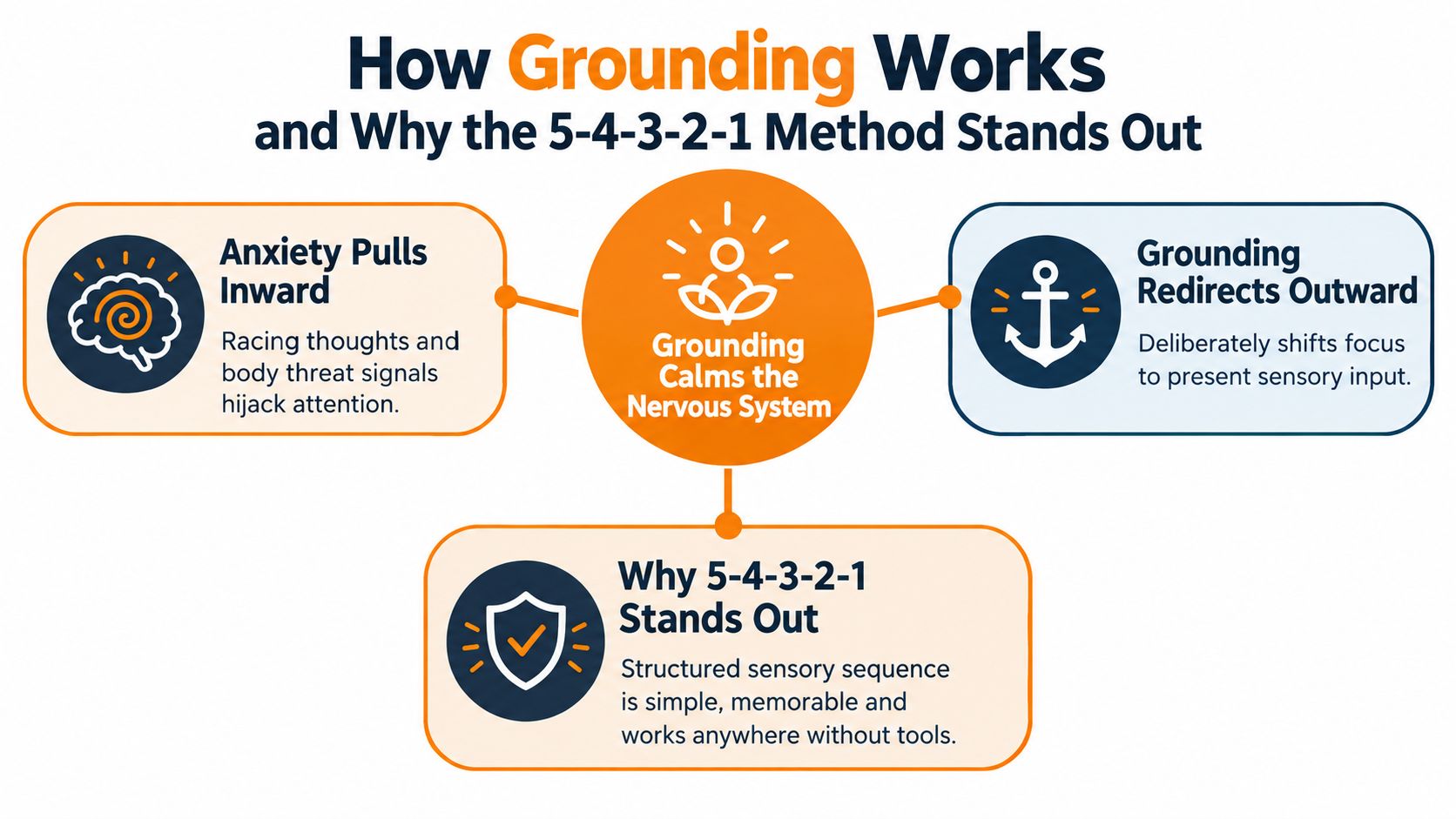
Anxiety pulls attention inward. The mind scans for danger, the body sends threat signals, and everything gets filtered through that narrow lens. Grounding works by shifting attention outward through the senses. That gives the brain real, present-moment information instead of only the alarm signal coming from the body.
That shift matters for teens because anxiety can narrow the world fast. A normal school day can suddenly feel unsafe, embarrassing, or impossible. Sensory grounding helps widen the lens again. It can be used in a classroom, bathroom, car, hallway, counselor's office, or bedroom. It does not require special equipment or a perfect environment.
Why it helps: the method gives anxious attention something concrete to do, one sense at a time.
Compared with other anxiety tools, 5-4-3-2-1 has a specific job. Box breathing can help when breathing is fast and shallow. Progressive muscle relaxation can help when the body is holding tension. Cognitive reframing works better once the nervous system has settled enough to think clearly. Sensory grounding often comes first because teens can use it in the middle of real life, including school or social stress.
If you want a deeper pairing for the nights when the mind keeps racing, CBT techniques for sleep can complement grounding by giving the brain a different kind of off-ramp. The same principle shows up in mindfulness practice too, and a simple mindfulness routine for teens can make the grounding sequence feel less unfamiliar when stress spikes.
The goal is not to call one coping skill magical. The goal is to make 5-4-3-2-1 the first reliable anchor, then build a fuller coping toolkit around it.
How to Use the 5-4-3-2-1 Grounding Method Step by Step
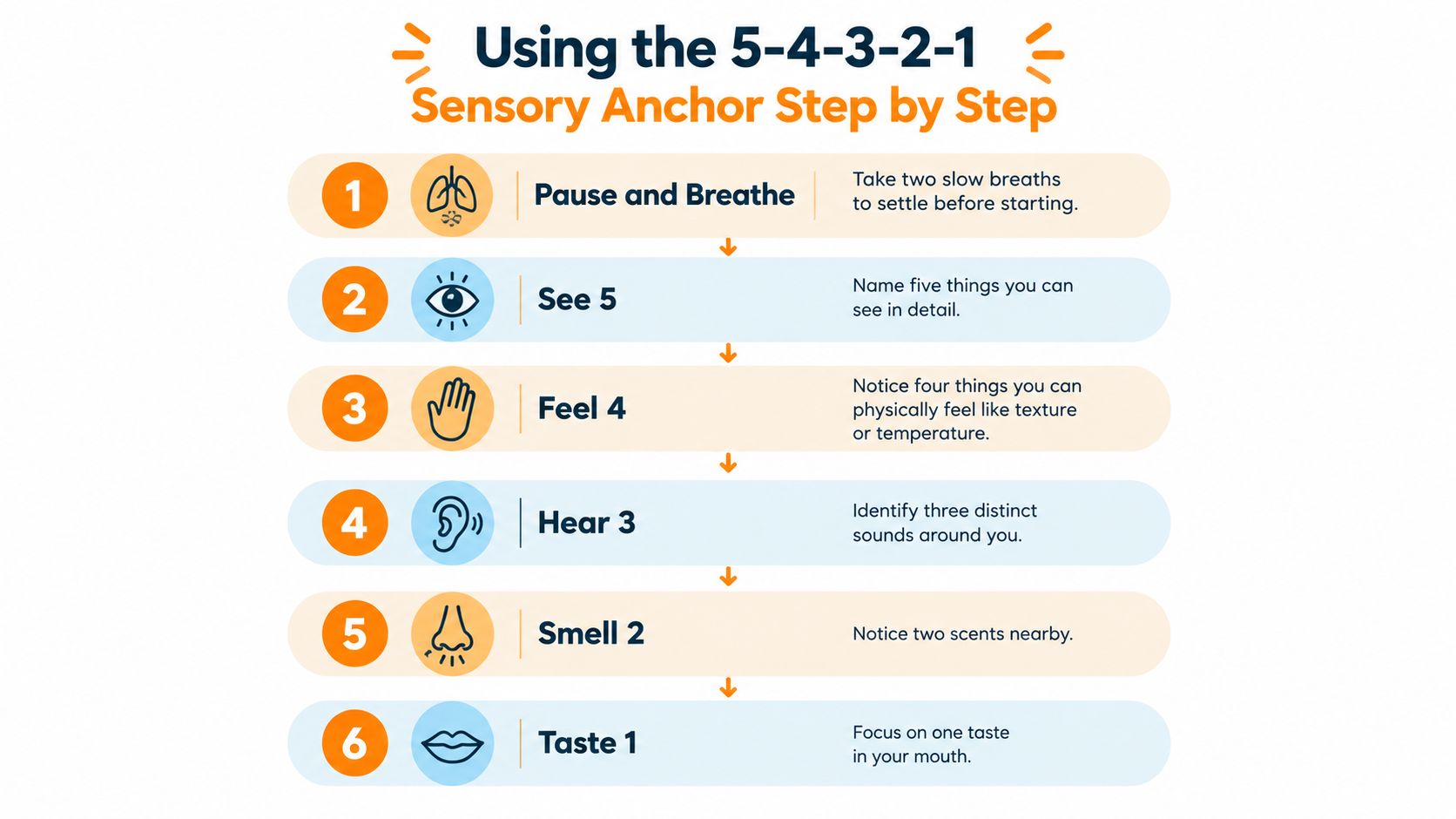
Start with two slow breaths. Not huge breaths, just enough to settle the body before the scan begins. Then move through the senses in order. A full round usually takes two to three minutes, with about 30 seconds per sense if the pace is steady.
1. Name 5 things you can see
A teen in a hallway might notice floor tiles, a clock, a backpack zipper, the edge of a bulletin board, and the color of a classroom door. The goal is not to be poetic. The goal is to notice what is actually there.
2. Name 4 things you can feel
This might be shoes against the floor, a sweatshirt on the arms, the chair under the legs, or cool air on the face. Touch often helps quickly because it brings attention back into the body.
3. Name 3 things you can hear
Maybe it is the hum of a vent, voices down the hall, or a locker shutting. These sounds do not have to be pleasant. They just have to be real and present.
4. Name 2 things you can smell
Soap, paper, cafeteria food, shampoo, or even the neutral smell of the room can count.
5. Name 1 thing you can taste
Gum, water, toothpaste, a mint, or whatever taste is already in the mouth works fine.
Repeat the sequence slowly enough that your brain has time to notice each answer.
The mistakes are predictable. Teens often rush the list, stop after sight, or skip smell and taste because those feel awkward. Others do the whole thing silently and so quickly that they never feel the grounding effect. Saying the answers out loud, when possible, often works better because it naturally slows the process.
The most useful habit is to practice in calm moments. Rehearse it twice a day when anxiety is low, so the sequence already feels familiar when stress rises.
Quick version for teens in public
If a full round feels too long in class or around friends, shorten it:
3 things you see
2 things you feel
1 thing you hear
That shorter version can still interrupt the spiral and buy enough time to stay in the situation.
When Teens Can Use 5-4-3-2-1 at School, Home, and Social Events
Teens do better with coping skills when they can picture using them in real situations. Here is what that looks like.
Situation | Best Pace | Priority Senses | Watch Out For | What Success Looks Like |
|---|---|---|---|---|
Before a test | Steady, forward-moving | Sight, touch, sound | Jumping ahead to the grade | You stay in the room and start the test |
In a crowded hallway | Brief and focused | Sight, touch | Scanning for exits only | You keep moving instead of freezing |
At a party or social event | Slower, body-focused | Touch, sound, sight | Overchecking how you look | Self-consciousness drops a notch |
During family conflict | Deliberate and low-drama | Sight, touch, sound | Trying to win the argument while grounding | You stay present without escalating |
During panic | Very slow, breath-matched | Touch, sound, sight | Expecting panic to vanish instantly | The wave softens enough to ride it |
School stress: In a classroom or hallway, the mind wants to jump to outcomes, grades, embarrassment, or worst-case stories. Grounding brings focus back to the actual room and the next small task.
Social anxiety: Before a presentation, at lunch, or at a party, self-monitoring gets loud. Touch often works best here, feet on the floor, clothes on the skin, a phone in the hand, or the weight of a backpack.
Family conflict: When a teen feels cornered, the room can get emotionally flooded fast. Naming a lamp, a mug, a picture frame, or the edge of the counter can create enough distance to stop the moment from getting bigger.
Panic: This is the hardest test. The method usually does not erase panic immediately. What it does is help the teen stay oriented, breathe, and let the wave peak without adding more fear to it.
What to Do When the Skill Does Not Seem to Work
Most failures come from a few repeatable mistakes, and each one has a fix.
1. The breathing is too shallow
Some teens hold their breath while scanning the senses, which keeps the body in alarm mode. Start with a slow inhale, then breathe normally during the exercise.
2. The pace is too fast
Sight is easy, so people often rush it and never truly arrive in the other senses. Stay with each sense for at least fifteen seconds when possible.
3. The person gives up too soon
Anxiety often peaks before it settles. The first wave can feel like proof the skill failed. Finish one full round before deciding whether it helped.
4. Grounding turns into avoidance
If a teen uses grounding to dodge every hard feeling forever, it stops being regulation and becomes a detour. It helps to end with one honest sentence, like: I am anxious about the presentation, or I am upset about what happened at lunch.
A quick self-check can help:
Breath got stuck: you were counting senses while barely inhaling.
Speed took over: the sequence felt rushed or mechanical.
Judgment got loud: you decided it did not work before finishing.
The room was too much: you may need less stimulation or a safer spot first.
If panic keeps taking over despite practice, a more guided approach can help. The practical panic tools in this family counseling resource fit well alongside grounding, especially when a teen needs a simple script to remember under stress.
How Parents Can Support a Teen Without Making Anxiety Worse
Parents usually mean well when they move quickly into problem-solving. But when a teen is flooded, explanations often land as pressure. A better first response is regulation before reasoning.
Here are a few ways parents can help:
Model calm first. A regulated parent gives a teen's nervous system something steadier to borrow.
Keep language simple. Try, Let us slow this down, or Name five things you can see.
Do not demand perfect eye contact or a full explanation right away. Lower activation first.
Practice when things are calm. Skills learned outside the crisis are easier to use during one.
Praise use of the skill, not just outcomes. A teen who stayed in class for five more minutes used the skill successfully, even if they still felt anxious.
This is one reason family counseling can be so helpful. It gives both the teen and the parent a shared plan for what to do in the moment.
When to Get Professional Help for Teen Anxiety
A teen can use 5-4-3-2-1 correctly and still need more support. Grounding works best as part of a realistic anxiety toolkit.
If anxiety shows up mostly as racing thoughts, cognitive labeling can help by naming thoughts without treating them like facts. If anxiety shows up in the body as restlessness or tight muscles, short bursts of movement may work better than forcing stillness. Structured breathing can also help when the nervous system is highly activated.
Some teens need support that goes beyond self-help. CBT and exposure-based work strengthen grounding because the body gets repeated practice staying present while discomfort rises and falls. Neurofeedback may also help some teens access calmer states more consistently, especially when the body stays on high alert.
It is time to look for extra help when:
anxiety is disrupting sleep, school, sports, or friendships
panic episodes are increasing
school refusal starts building
irritability or shutdowns are becoming frequent at home
coping skills help only a little, or only sometimes
Good enough is still useful. A skill that lowers the intensity even a little can keep the spiral from getting worse. But if anxiety keeps overrunning daily life, the answer is not to tell a teen to try harder. It is to build a stronger support plan.
For sensory support at home, the bergamot essential oil benefits guide gives ideas for pairing scent with grounding in a way that can fit into a calm routine.
Katy Teen & Family Counseling works with teens, young adults, and families who need practical anxiety support, family therapy, CBT-informed care, and in-house neurofeedback in Katy, Texas. If grounding helps only part of the time and you want help building a fuller plan around school stress, panic, or family conflict, visit Katy Teen & Family Counseling to explore care that fits real life.
About the Author

Jason Drake is a Licensed Clinical Social Worker, Board Certified in Neurofeedback Associate Fellow, EMDR trained, and a Certified Brain Health Professional through the Amen Clinics. He has worked with teens, young adults, and families since 2003 and serves as Owner and Lead Clinician at Katy Teen & Family Counseling and Katy Counseling for Men.
He specializes in supporting high performing therapy teams focused on teen therapy, young adult counseling, and family counseling. Jason also provides expert coaching and technical assistance to teen residential treatment centers across the country and regularly contributes to mental health publications. You can explore more of his work on the Featured Articles page.
He has also appeared on Fox 26 Houston and podcasts including Grow a Group Practice, Let's Talk With Jennifer B, and Marketing Matters.
If you are ready to start counseling, contact us today.


Comments