
Helping Teens Overcome Shame and Build Self-Confidence Through Individual Counseling


Your teen gets home, drops their backpack by the door, and heads straight to their room. The group chat has gone quiet after a joke landed badly at lunch, and now they will not answer questions, will not look up, and will not explain what happened. To a parent, it can look like attitude or normal moodiness, but shame often sounds like silence, hiding, and a quick decision that says, “I should not be seen right now.”
That is different from ordinary self-doubt. Self-doubt says, “I am nervous about this presentation.” Shame says, “Everyone knows I am a mess.” When that feeling starts running the show, teens often protect themselves by withdrawing, getting defensive, or pretending they do not care, even when they care a lot.

Families in Katy and across the Houston area often start searching for help when this pattern keeps repeating at home, at school, and with friends. A teen can look fine on the outside while carrying a heavy inner story that says they are not enough. If you are trying to make sense of that and figure out what helps, this guide walks through what shame is, how it affects teen confidence, why individual counseling for teens can help, and what parents can do next.
Table of Contents
Understanding How Shame and Self-Confidence Work in Teens - The loop parents keep seeing at home - Shame, guilt, embarrassment, and low self-esteem
Why Shame Takes Hold in Teens - When shame and self-esteem start feeding each other
How Individual Counseling Helps Teens Overcome Shame and Build Confidence - Why one-on-one support works differently - What confidence looks like inside the counseling room
What to Expect in a Teen Counseling Session - What the flow usually feels like - What parents usually want to know
How to Tell If Individual Counseling Is Right for Your Teen - Questions that help you find the right therapist
Understanding How Shame and Self-Confidence Work in Teens
Shame works like an inner critic that stops describing behavior and starts describing identity. A teen who forgets homework might hear, “I am irresponsible,” instead of, “I forgot something.” That shift matters, because once a mistake becomes a label, the teen’s brain starts treating every new challenge like proof that the label is true.
Confidence works more like an inner coach. It does not pretend mistakes are fun, but it speaks in a steadier voice: “You can learn this,” “Try again,” and “One bad day does not decide who you are.” That difference sounds small, yet it changes how a teen handles awkward moments, tests, social stress, and friendship drama.
Practical rule: shame shrinks a teen’s world. Confidence helps it open back up.
The loop parents keep seeing at home
A shame loop usually starts with a painful moment, then the teen adds meaning to it. The thought becomes, “They laughed, so I am embarrassing,” the feeling turns heavy, and the behavior changes. Maybe they stop talking in class or avoid the friend group. The more they withdraw, the fewer chances they have to feel safe again, which makes the story feel even more believable.
That is where self-compassion can interrupt the loop. Instead of attacking themselves, teens learn to respond as they would to a friend who blew up, froze, or got rejected. In a stressful developmental stage where peer judgment feels loud, that softer response gives the nervous system a different message: mistakes are real, but they are not identity.
Shame, guilt, embarrassment, and low self-esteem
Parents often lump these together, but they are not the same. Guilt says, “I did something wrong.” Embarrassment says, “That was awkward.” Low self-esteem is a broader habit of seeing oneself through a negative lens. Shame goes deeper and says, “Something is wrong with me.”
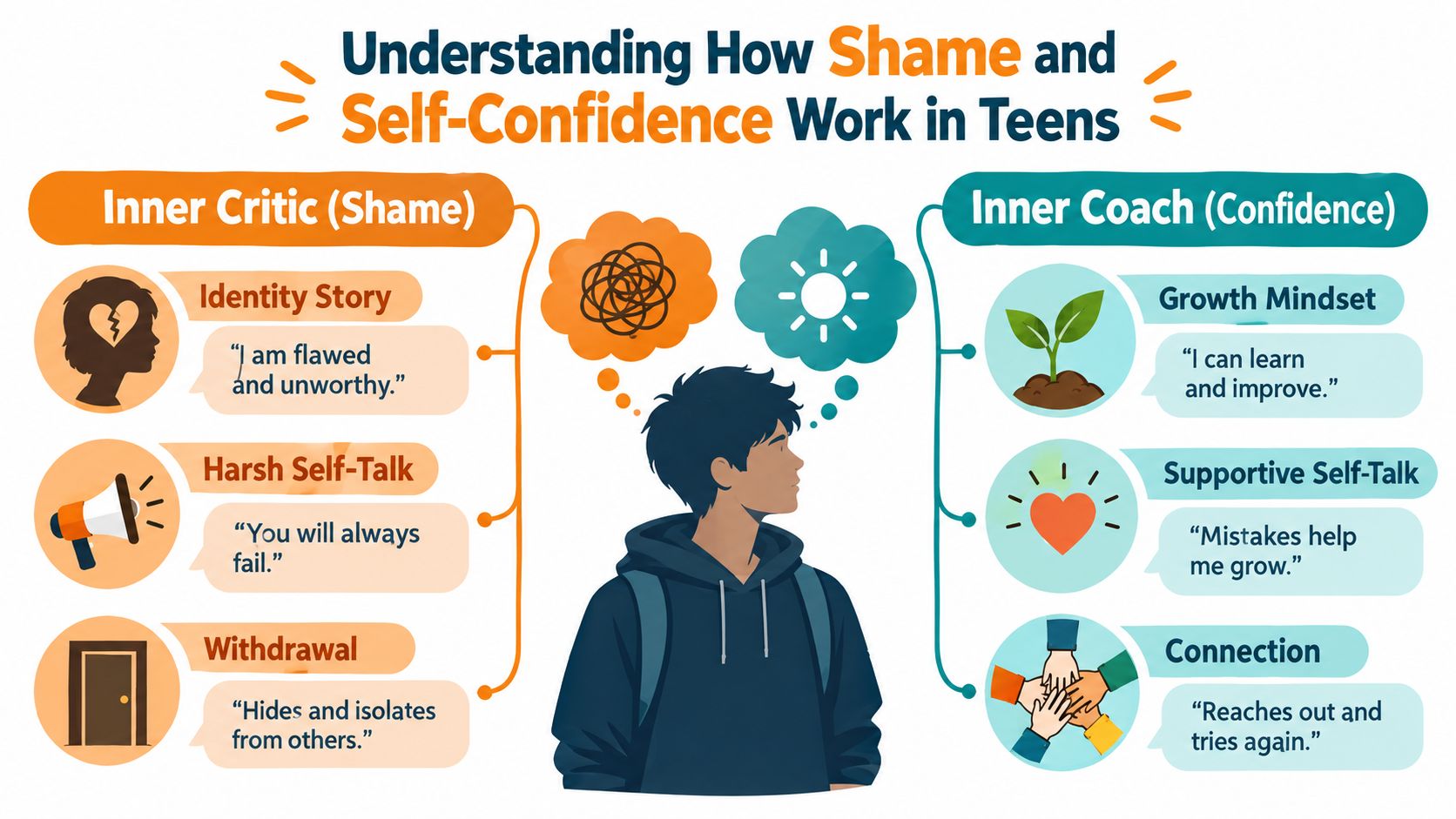
That identity-level message is why confidence cannot be built through praise alone. A teen needs repeated experiences of being understood, trying again, and hearing a kinder internal voice grow louder than the critic.
For a deeper clinical look at toxic shame, see understanding the impact of toxic shame, helping teens heal.
Why Shame Takes Hold in Teens
A teen who gets mocked, left out, or watched closely often starts to build a shield out of shame. The mind tries to protect them by saying, “Stay small, do not stand out, do not give anyone more reason to hurt you.” That protection can help in the moment, but it also teaches the teen to treat ordinary mistakes like proof that something is wrong with them.
Bullying gives that pattern a place to settle in. The CDC reported that 34.0% of U.S. teenagers ages 12 to 17 were bullied in the past 12 months from July 2021 to December 2023, and 1.7% were bullied almost every day (CDC data brief). In the same brief, bullied teens were nearly twice as likely to report anxiety symptoms, 29.8%, or depression symptoms, 28.5%, in the last two weeks compared with teens who were not bullied. Repeated mistreatment teaches a teen to brace for rejection before they even enter the room.
The pattern shows up far beyond one school building. An international review found that roughly 10% to 30% of adolescents worldwide are victims of school bullying, and a cross-sectional study across 28 Western countries found that around 41% of students experienced bullying. Another study of 151,184 school-going students across 40 low- and middle-income countries found that 28.7% had been bullied for at least one day, with the highest rates among students aged 11 to 13 years. Those findings help parents see that shame often grows in common social conditions, not in a teen’s character.
When shame and self-esteem start feeding each other
A large review found bullying victimization was associated with poor mental health outcomes, including depression, anxiety, suicidal ideation, and suicide attempts, with an odds ratio of 1.60 for poor mental health in children and adolescents (international review). Shame and self-esteem also tend to move in opposite directions. One line of research found a large negative correlation, r = -0.643, p < .001, which means that as shame rises, self-esteem tends to fall sharply.
That helps explain why comparison feels so draining. Social media, school pressure, and friend-group politics keep teens scanning for signs that they are behind, awkward, or unwanted, and that scan can turn into self-criticism fast. A teen who already feels exposed will often read neutral feedback as evidence that they are failing.
One practical example shows up around personal habits, too. If a teen already feels judged, even a concern that seems unrelated, like noticing a persistent social problem such as lasting bad breath solutions, can become another reason to hide instead of ask for help. The issue is usually not the topic itself, it is the shame attached to it.
For a deeper clinical look at toxic shame, see understanding the impact of toxic shame, helping teens heal.
How Individual Counseling Helps Teens Overcome Shame and Build Confidence
Individual counseling gives teens something shame rarely allows, a private space to say what they are actually thinking without worrying about peer reactions. In one-on-one therapy, a teen can slow down, name what hurts, and begin separating a painful experience from a fixed identity. Instead of carrying the belief that they are broken or not enough, they can start learning how shame formed and how to respond to it differently.
A licensed therapist helps teens notice patterns that often stay hidden in everyday life. That can include harsh self-talk, people-pleasing, perfectionism, shutdown, irritability, or the habit of assuming the worst after one bad moment. When those patterns are brought into the open, they become easier to work on with practical tools and steady support.
Why one-on-one support works differently
Some teens open up more easily in private. They may feel safer talking honestly about bullying, social anxiety, family stress, academic pressure, identity concerns, or a mistake they cannot stop replaying. In teen counseling, the therapist can tailor each session to that teen’s pace, personality, and needs instead of balancing multiple voices in the room.
Individual therapy also creates space for deeper work. A therapist can help a teen challenge distorted thoughts, build self-compassion, regulate strong emotions, and practice healthier ways to handle stress. Approaches such as CBT, trauma-informed counseling, and skills-based emotional support can help teens move from “Something is wrong with me” to “Something hard happened, and I can learn how to handle it.”
What confidence looks like inside the counseling room
Confidence does not usually arrive as a sudden personality change. It looks more like a teen answering a question honestly, admitting they felt hurt instead of pretending they did not care, or noticing an inner critic before believing it automatically. Those small shifts matter because repeated safe conversations teach the brain that being known does not always lead to rejection.
A helpful way to think about it is this: individual counseling does not just tell teens to be less ashamed. It gives them a place to understand where shame came from, learn new emotional skills, and practice a kinder relationship with themselves.
For a local overview of support options, see what is group therapy for teens and how can it help my teenager.
What to Expect in a Teen Counseling Session
A first session usually feels more structured than a teen expects. The therapist starts by getting to know the teen, asking about stress at school, friendships, family dynamics, mood changes, and what feels hardest right now. Early sessions also focus on helping the teen feel safe enough to talk without pressure.
What the flow usually feels like
The first few minutes often focus on easing nerves. A teen may check in about the week, describe a situation that is bothering them, or talk through a recent moment where they felt embarrassed, rejected, or overwhelmed. From there, the therapist may help them identify a thought pattern, practice a coping strategy, or work through a specific situation in a more grounded way.
Good counseling makes room for hesitation. A teen does not have to be eloquent to benefit. They just have to be willing to show up and try.
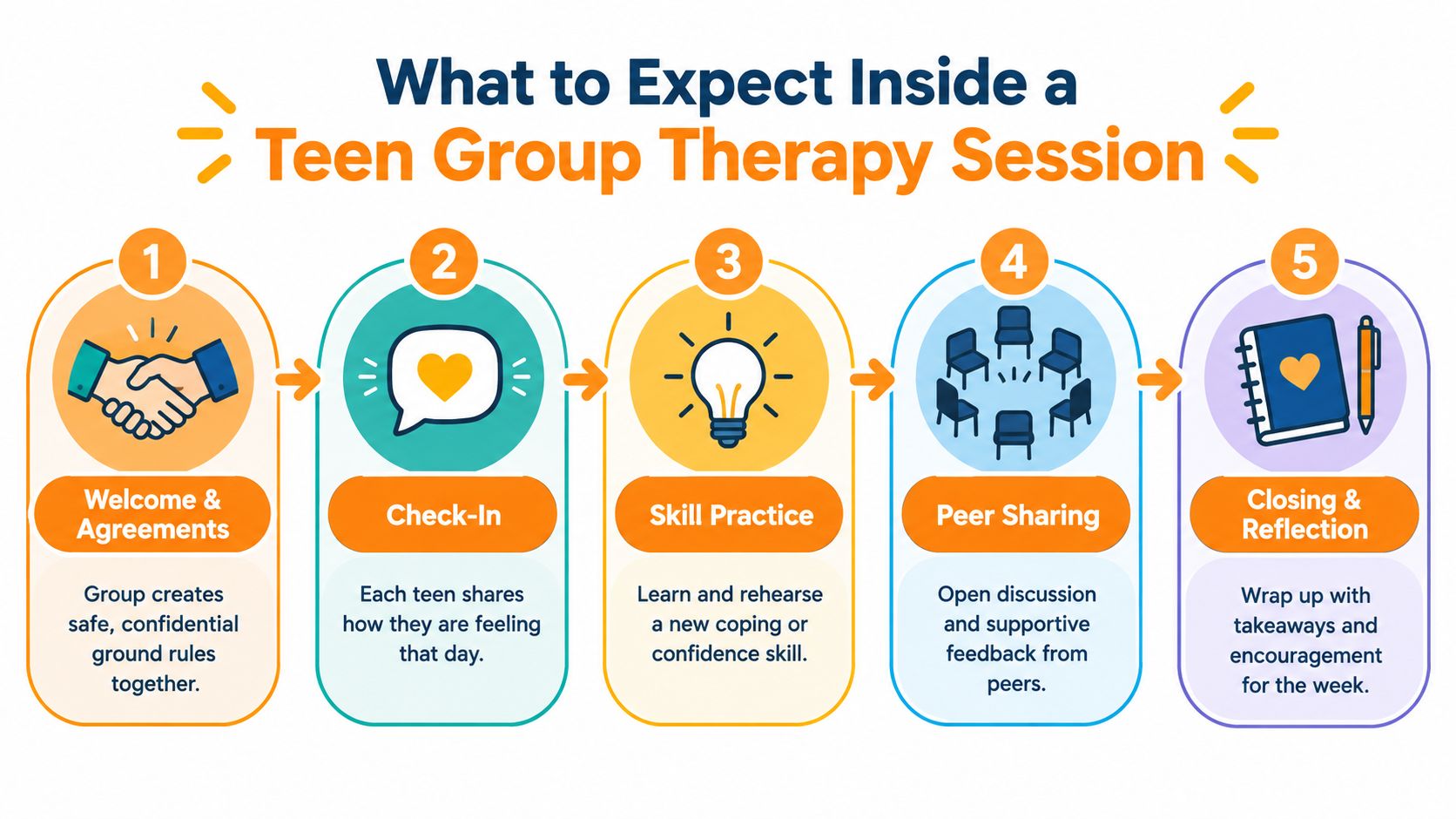
Over time, sessions often move beyond immediate stress into deeper patterns. A therapist may help the teen challenge negative beliefs, understand emotional triggers, improve self-talk, and build confidence through repeated practice. Progress usually happens in steps, not all at once, but even small changes can have a meaningful effect on daily life.
What parents usually want to know
Confidentiality is a major concern, and it should be. Teens need to know that what they share is respected, while parents also need clarity on how safety concerns are handled. Good therapists explain those boundaries early so trust can grow.
Parents also want to know how long it takes to see progress. The answer depends on the teen, the concerns involved, and how long the shame pattern has been in place. Often, the first signs of change are subtle. A teen may shut down less, recover faster after a hard day, or use better language for what they feel. Those shifts matter because they often signal real internal progress.
How to Tell If Individual Counseling Is Right for Your Teen
A teen who keeps saying, “No one gets it,” may not need more lectures. They may need a private space where they can talk honestly about shame, self-criticism, and the pressure they feel without worrying about how anyone else will respond. Teen counseling often fits when a teen is stuck in isolation, social fear, perfectionism, or constant second-guessing, especially if they avoid school, friends, or family conversation because of how they see themselves.
It also helps when a teen needs more than reassurance. Shame often works like a loop. The teen expects rejection, goes quiet, then reads that silence as proof that something is wrong with them. A good therapist interrupts that loop by helping the teen understand what is happening, challenge the inner critic, and practice new ways of responding.
Your Teen or Family Need | What to Look for in Counseling | Question to Ask the Provider |
|---|---|---|
Your teen hides a lot and rarely opens up | A therapist who is skilled at building trust with teens | How do you help teens open up without pressure? |
Your teen needs support for shame and self-criticism | A licensed clinician using CBT or related evidence-based methods | What approach do you use for shame, self-talk, and confidence? |
Your teen does better with practical support than lectures | Sessions that include coping skills, reflection, and emotional tools | What does a typical session look like from start to finish? |
Your family wants clarity on logistics | Clear scheduling, parent communication, and private-pay details | What are your fees, policies, and next steps if we want to begin? |
Questions that help you find the right therapist
Start with the basics. Look for licensed clinicians, experience working specifically with teens, and an approach that matches your teen’s needs. Ask whether the provider uses evidence-based methods such as CBT, how confidentiality works, and how parents are included in the process.
Logistics matter too. Private-pay practices should explain fees clearly and provide a Good Faith Estimate when required, so you are not guessing about cost. A good provider should answer these questions plainly, because serious care should be easy to understand.
A reputable counseling practice feels structured, not vague. If the explanation stays unclear, keep looking.
If you want one local option to review, specialized self-esteem counseling for teens in Katy, TX can help you compare what a focused teen service looks like alongside your other choices.
Next Steps for Families in Katy, Texas
A teen who carries shame alone often gets quieter, more guarded, and more convinced that something is wrong with them. Teen counseling can interrupt that loop. It gives teens a private space to talk honestly, understand the stories they are telling themselves, and build self-compassion with guidance from a trained therapist. For parents, that can be the difference between watching the pattern repeat and helping their teen move toward something healthier.
Katy Teen & Family Counseling offers individual counseling for teens along with family support at 23410 Grand Reserve Drive, Suite 401 in Katy. Their licensed clinicians also provide neurofeedback, EMDR, ART, CBT, family therapy, and parent guidance, and the practice notes 70+ years of combined experience serving teens, young adults, and families. When a teen’s care stays connected, it can feel less like piecing together separate fixes and more like following one clear plan.
For parents who want a closer look at counseling focused on self-worth and teen identity, specialized self-esteem counseling for teens in Katy, TX is a useful place to start. If you are ready to start counseling, contact us today.
About the Author

Jason Drake is a Licensed Clinical Social Worker, Board Certified in Neurofeedback, EMDR trained, and a Certified Brain Health Professional through the Amen Clinics. He has worked with teens, young adults, and families since 2003 and serves as Owner and Lead Clinician at Katy Teen & Family Counseling and Katy Counseling for Men.
He specializes in supporting high performing therapy teams focused on teen therapy, young adult counseling, and family counseling. Jason also provides expert coaching and technical assistance to teen residential treatment centers across the country and regularly contributes to mental health publications. You can explore more of his work on the Featured Articles page.
He has also appeared on Fox 26 Houston and podcasts including Grow a Group Practice, Let's Talk With Jennifer B, and Marketing Matters.
If you are ready to start counseling, contact us today.


Comments