
Neurofeedback for ADHD in Katy, TX: Restoring Teen Focus


Imagine another Friday afternoon where your phone rings and your heart sinks because you already know it's the school calling about your teen again. It's painful to watch your gifted child struggle with impulsivity while the atmosphere at home remains fractured by conflict.
You aren't alone in seeking a way to help them thrive, and many local parents are now discovering neurofeedback for ADHD Katy, TX as a path to lasting change. Whether you're exhausted by teacher reports or worried about your teen's fading confidence, you deserve a solution that's both scientific and supportive.
This specialized therapy provides a sophisticated, non-invasive way to help your teen's brain find its natural rhythm. By focusing on physiological recalibration, we train the brain for enduring focus and emotional stability. We'll explore how these evidence-based sessions foster a more peaceful home environment and empower your teen to feel truly capable again.
Table of Contents
Understanding the ADHD Brain: Why Traditional Support Often Falls Short for Katy Teens
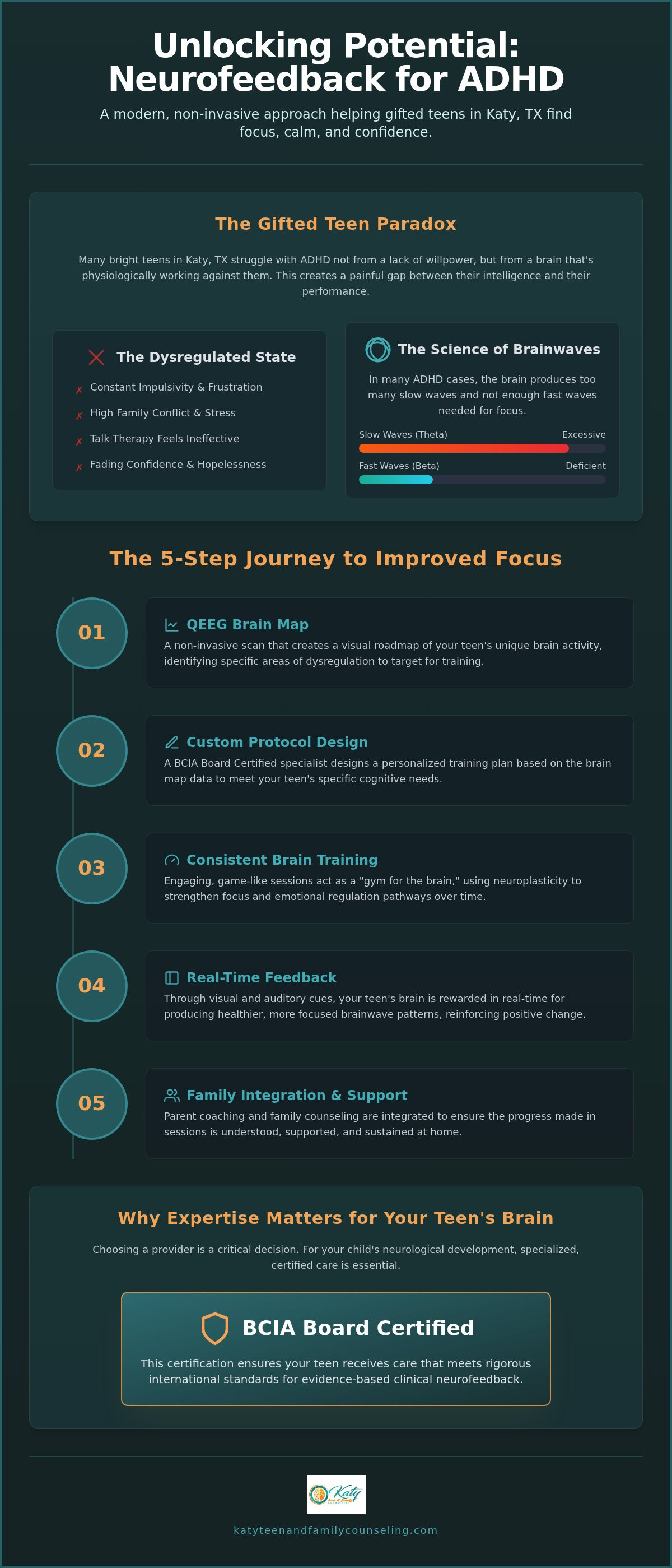
ADHD is rarely a matter of willpower. For many high-achieving teens in Katy, TX, it's a physiological reality where the brain works against their best intentions. They want to focus. They want to excel. Yet, their internal engine is misfiring. This creates a painful paradox where a gifted student feels like a failure because they can't bridge the gap between their intelligence and their performance. This disconnect often leads to high family conflict and a sense of hopelessness for parents who understand the intense academic pressure in local schools.
Traditional teen therapy is often the first stop for families. However, if the brain is dysregulated, talk therapy can feel like pushing a boulder uphill. When the biological hardware isn't functioning, behavioral software updates have nowhere to land. It's a frustrating cycle that leaves both the teen and the parents feeling depleted.
We focus on neuroplasticity instead. This is the brain's innate ability to reorganize itself. Learn more about neurofeedback and how it utilizes this natural process to foster resilience and cognitive clarity.
Beyond Medication: The Science of Regulating the ADHD Brain
Medication often masks symptoms without addressing the root cause of the struggle. In many ADHD cases, the brain produces too many slow Theta waves and too few fast Beta waves. Fast waves are essential for alertness and executive function.
Specialized neurofeedback for ADHD in Katy trains the brain to shift into a more regulated state. Neurofeedback provides the physiological foundation that allows behavioral strategies to finally take root.
The Journey of Transformation: A Case Study of Neurofeedback for ADHD in Katy, TX
Alex, a gifted sophomore in Katy, TX, felt like he was drowning. Despite his high IQ, academic probation loomed, and every dinner ended in an argument about unfinished chores. Whether he was staring at a blank screen during a test or reacting impulsively to a simple request, the frustration was constant. His parents felt like they were losing their son to a cycle of impulsivity and shame. This is the reality for many families who seek out neurofeedback for ADHD. Alex didn't need more discipline; he needed a brain that could sustain attention.
During his initial assessment, we used a QEEG brain map to visualize exactly where his neural pathways were struggling. Unlike traditional methods that rely solely on observation, this data-driven approach provides a clear roadmap for change.
Research, including a systematic review of neurofeedback training, highlights how this targeted approach supports cognitive restoration. For Alex, the sessions felt like playing a video game using only his mind. It was engaging, non-invasive, and gave him a sense of mastery he hadn't felt in years.
Alex didn't just see his grades improve; he felt a newfound sense of agency over his own mind. If your family is ready to start a similar journey, you can reach out to our specialists today.
The 5-Step Process to Improved Focus and Emotional Control
Step 1: The QEEG Brain Map identifies specific areas of dysregulation and provides a visual baseline.
Step 2: A custom protocol is designed by a BCIA board-certified specialist to meet your teen's unique needs.
Step 3: Consistent training sessions act as a "gym for the brain," strengthening focus over time.
Step 4: Real-time feedback helps the teen recognize and reward regulated states through auditory and visual cues.
Step 5: Integration with family counseling and parent coaching ensures progress is sustained in the home environment.
Choosing the Right Path: Why Specialized Neurofeedback in Katy, TX Makes the Difference
Selecting a provider is a significant decision for your family's future. Expertise matters deeply for your child's neurological development. This is why our lead therapist is BCIA Board Certified, ensuring your teen receives care that meets rigorous international standards. Unlike general clinics, the Katy Teen & Family Counseling approach is specifically tailored to the unique developmental needs of adolescents.
We understand the academic rigors of local schools and the social pressures your teen faces every day. Our mission extends beyond simple symptom management; we are dedicated to helping your teen become a wildly successful adult who feels confident and capable.
When researching neurofeedback for ADHD in Katy, look at current evidence and practice to ensure the intervention is grounded in clinical science. Our office is centrally located at 23410 Grand Reserve Drive to serve families throughout Katy, TX, Fulshear, and Richmond.
We provide a calm harbor where specialized wisdom meets compassionate care, making it easy for busy families to prioritize this life-changing training. Whether you are at the beginning of your search or ready to begin sessions, we meet you with steady confidence and specialized understanding.
The Power of Integrated Care: Combining Brain Training with Family Support
We don't believe in treating a teen in isolation. True healing occurs when the entire family system is supported and validated. By incorporating parent coaching alongside brain training, we help you navigate the behavioral shifts that follow physiological change.
As your teen’s ADHD symptoms subside, the constant friction in your home begins to dissolve. This allows the parent-teen bond to be rediscovered, fostering a home environment that feels peaceful rather than polarized. For more detailed insights into this process, explore our Neurofeedback for Focus in Katy: Parent’s Guide.
Reclaiming Your Teen's Future and Family Harmony
Your teen's struggle with ADHD doesn't have to define your family's story. By shifting the focus from willpower to physiological regulation, you provide your child with the biological foundation they need to thrive. You've learned how evidence-based brain training moves beyond masking symptoms to foster lasting cognitive resilience.
At Katy Teen & Family Counseling, we specialize in this journey of restoration for both the teen and the family unit. We understand the unique pressures of life in Katy, TX and are here to help.
Our practice is led by Jason Drake, LCSW, BCN-L, a BCIA Board Certified Specialist committed to the highest standards of care. We are conveniently located at 23410 Grand Reserve Drive, Ste. 401, Katy, Texas 77494.
Choosing neurofeedback for ADHD in Katy, TX is a powerful step toward restoring focus and bringing peace back to your home. Schedule your teen’s neurofeedback consultation in Katy, TX today. We are ready to help your family find steady ground and lasting hope.
Frequently Asked Questions About Neurofeedback for ADHD in Katy, TX
Is neurofeedback for ADHD permanent, or will my teen need it forever?
For many teens, the improvements gained through neurofeedback are long-lasting because the brain is learning a new, healthier way to regulate itself. Think of it like physical therapy: once the brain consolidates these stronger neural patterns, they tend to hold. Some individuals benefit from periodic maintenance sessions during high-stress periods, such as final exams, but ongoing weekly training is not typically a lifetime requirement.
How long does it take to see results from neurofeedback for ADHD in Katy, TX?
Results vary depending on each teen's unique brain map and the severity of dysregulation identified during their initial QEEG assessment. Many families begin noticing subtle shifts in mood and focus within the early weeks of consistent training. Meaningful, sustained changes in attention and emotional regulation generally emerge as the sessions progress and the brain's new patterns become more firmly established over time.
Is neurofeedback therapy safe for teenagers with ADHD?
Neurofeedback is a non-invasive therapy that involves no medication, no electrical stimulation, and no discomfort. It works by providing the brain with real-time information about its own activity, allowing it to self-correct naturally. At Katy Teen & Family Counseling, all neurofeedback sessions are guided by Jason Drake, a BCIA Board Certified specialist, ensuring your teen's care meets rigorous clinical and safety standards.
How does neurofeedback compare to ADHD medication?
Medication can reduce symptoms while it's active in the system, but it doesn't retrain the brain's underlying patterns. Neurofeedback works differently by targeting the root physiological dysregulation, specifically the imbalance between slow and fast brainwave activity. Rather than masking the challenge, it builds the brain's capacity for self-regulation. Families often explore neurofeedback as a complement to existing support or as a standalone, drug-free alternative worth discussing with their care team.


Comments