
What Causes Depression in Teenagers? Finding Help


A parent often notices the shift in quiet, ordinary moments first. A teen who used to text friends back right away starts going silent. Homework piles up. Family plans get brushed aside. When asked what is wrong, the answer is often, "nothing," even when something clearly feels off. That is usually when parents start asking an important question: what causes depression in teenagers, and when is it time to get help?
There is rarely one single cause. Teen depression often develops through a combination of biological, emotional, social, and environmental factors, and it does not always look the way adults expect. Some teens seem sad. Others look angry, exhausted, shut down, distracted, or constantly overwhelmed. Knowing what to look for can help parents respond with support instead of frustration.
If you are searching for answers about teen depression counseling, teen therapy, counseling for teenagers, or how to find a therapist for teens in Katy, TX, this blog post walks through common causes, signs to take seriously, and how to find the right kind of help.
Table of Contents
Recognizing the Signs of Teen Depression - Look for patterns rather than one isolated behavior
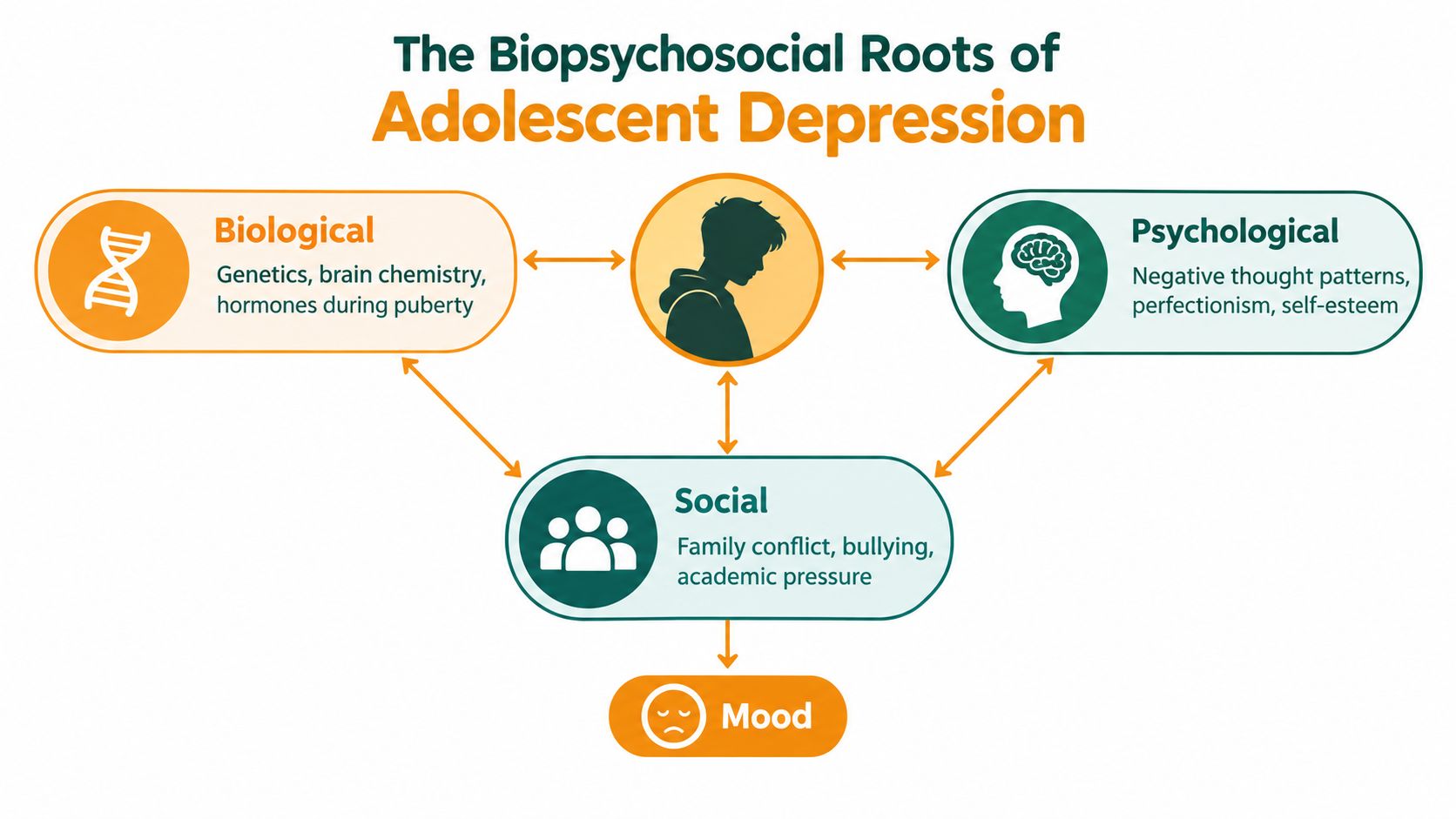
The Biopsychosocial Roots of Adolescent Depression - Biology changes the developmental context during adolescence - Psychological and social pressures accumulate
Environmental Triggers and the Social Media Myth - Ask what happens around the screen
How to Choose the Right Professional for Your Teen - Match the professional to the presenting need
The Value of Specialized and Integrated Care Models - Match the model to the clinical picture - Coordinate care when needs exceed one discipline
Recognizing the Signs of Teen Depression
For many families, concern begins with a series of changes that do not quite make sense on their own. A school counselor may mention missing assignments. A teen who once stayed connected with friends may start eating lunch alone. At home, parents may notice irritability, unusual sleep patterns, low energy, or repeated complaints about headaches or stomachaches.
No single behavior proves depression. Still, a pattern that lasts for weeks and begins affecting school, relationships, motivation, or daily functioning deserves careful attention.
Depression is more than a rough patch or a hard week. Warning signs can include persistent hopelessness, loss of interest, irritability, changes in sleep or appetite, difficulty concentrating, low self-worth, and withdrawal from friends or family. Physical symptoms can show up too, especially when a teen struggles to explain what they are feeling. The warning signs of teen depression can overlap with anxiety, trauma, substance use, medical issues, and normal developmental stress, which is why a thoughtful professional assessment matters.
For families looking for teen counseling in Katy, TX or therapy for teenagers in Katy, it helps to know that support does not have to wait until things feel severe. Many teens benefit from counseling well before a situation turns into a crisis.
Look for patterns rather than one isolated behavior
A teen sleeping late over a school break is not necessarily a warning sign. One disappointing grade does not automatically point to depression. What matters more is whether the change is ongoing, disruptive, and clearly different from your teen's normal baseline.
A few questions can help:
What has changed? Notice shifts in routines, hygiene, friendships, school habits, confidence, and emotional reactions.
How long has it been going on? A difficult day is different from a sustained pattern.
Where does it show up? Some teens mask distress at school and unravel at home. Others withdraw everywhere.
What is your teen saying? Comments about hopelessness, worthlessness, death, or being a burden should always be taken seriously.
The goal is not to build a case against your teen. It is to open the door to a better conversation. Saying, “I have noticed you seem drained and more distant lately. I want to understand what this has been like for you,” usually goes further than asking, “Why are you acting like this?”
Practical rule: A lasting change in functioning is a reason to get curious and seek support, not a reason to assume laziness, attitude, or attention-seeking.
Patterns also help families decide where to start. Some teens need therapy right away. Others may need a more complex evaluation. If your teen is dealing with mood changes, school stress, or withdrawal, starting with teen counseling in Katy, TX can be a practical next step.
If your teen mentions self-harm or suicide, seek immediate support. In an urgent crisis, call 988 or 911, go to the nearest emergency room, or use the 988 Lifeline for crisis guidance.
The Biopsychosocial Roots of Adolescent Depression
One of the hardest parts of teen depression is that it rarely comes from just one place. A teenager may be biologically vulnerable, emotionally overwhelmed, socially isolated, or dealing with several pressures at once. Family history, hormonal shifts, bullying, trauma, school stress, conflict at home, and painful relationship experiences can all interact.
That is why asking only, “What caused this?” can sometimes be too narrow. A better question is, “What combination of factors may be contributing to what my teen is experiencing right now?”
Biology changes the developmental context during adolescence
Depression becomes more common as children move into the teenage years. In the United States in 2016, about 5% of 12-year-olds and 17% of 17-year-olds reported a major depressive episode during the previous 12 months, according to the American Academy of Family Physicians. That does not mean puberty alone causes depression. It does suggest that adolescence is a period when vulnerability can increase because so many changes are happening at once.
Family history matters too. A parent's depression can increase risk, especially when it has been recurrent, severe, or present across generations, as described in this review of depression in young people. Still, family history is not destiny. Early support, better communication, healthy sleep, and timely assessment can all make a meaningful difference.
Psychological and social pressures accumulate
Teenagers do not just react to events. They also react to what those events mean to them. A setback that looks manageable to an adult may feel crushing to a teen who is perfectionistic, anxious, traumatized, socially excluded, or already struggling with low self-esteem.
Depression can also feed on itself. A teen feels overwhelmed, so they avoid schoolwork or pull back from friends. That leads to more stress, more conflict, and more hopelessness. Over time, the cycle gets stronger.
A review of first-onset depression found that young people with another mental health problem at baseline had a notably higher risk of later first-onset depression, with OR = 3.20. That is one reason good counseling looks at the whole picture, not just mood in isolation.
Families searching for teen depression counseling Katy TX, young adult counseling Katy TX, or family counseling Katy TX often benefit from working with a clinician who can look at stress, relationships, coping patterns, and co-occurring concerns together.
Parents seeking integrated biopsychosocial support for teen depression should expect treatment to address both symptoms and the conditions keeping those symptoms in place.
Environmental Triggers and the Social Media Myth
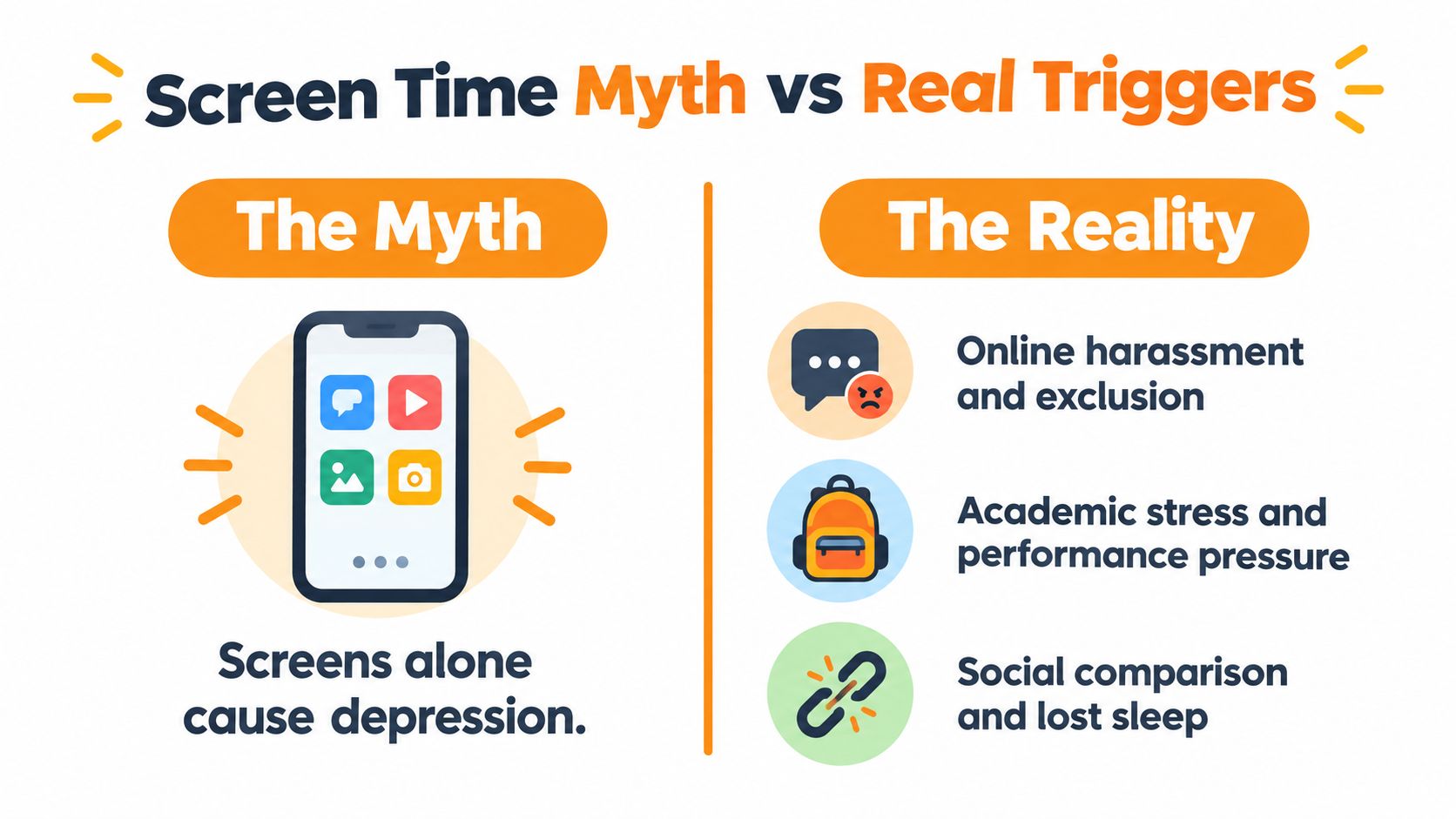
Parents often hear broad statements like “social media is causing teen depression,” but real life is usually more nuanced than that. Screens can absolutely play a role, especially when they expose a teen to bullying, exclusion, appearance pressure, or poor sleep. At the same time, online spaces can also offer connection, support, and a sense of belonging.
The real question is not whether social media is universally bad. The better question is how a specific teen is being affected by what happens online.
Recent research highlights an important gap between what teens and parents notice. Teens point to several pressures, including social media, bullying, and broader expectations, while parents often focus more heavily on social media by itself. The Pew Research Center report on teens, social media, and mental health also describes social media as capable of creating both supportive and harmful experiences.
Ask what happens around the screen
If a parent sees a teen on their phone late at night, it is easy to assume the device itself is the core issue. But often the more useful question is what the teen is experiencing through the device. Are they being left out? Harassed in a group chat? Comparing themselves to edited images? Staying awake because they are anxious about what they might miss?
Sleep deserves special attention. Research summarized in the Pew report links short sleep with more negative emotions the next day and greater long-term depression risk. Relational stress also appears to be a major pathway into depressive symptoms. In other words, taking away a phone may reduce one stressor, but it does not automatically solve loneliness, bullying, pressure, or family conflict.
School can be another major source of strain. Mayo Clinic's overview of teen depression identifies long-term bullying and academic problems as experiences that can damage self-esteem and raise depression risk.
A practical way to start the conversation is to:
Lead with curiosity: “What has felt hardest about being online lately?”
Separate use from impact: Ask how online experiences affect sleep, confidence, focus, and friendships.
Check the offline world too: Explore school stress, social conflict, loneliness, and tension at home.
Set limits collaboratively: Build boundaries that protect sleep and safety without dismissing the teen's social world.
The following video can help families think through the difference between digital habits and the emotional experiences attached to them.
For a more focused discussion of digital habits, parents can review the impact of social media on teenagers' mental health. The aim is not to blame one factor. It is to understand what is making life harder for this particular teen.
Psychologists vs Counselors, Understanding the Differences
When parents begin looking for help, it is common to wonder whether a psychologist or a counselor is the better choice. In reality, the answer depends less on the title and more on what your teen needs right now.
A psychologist typically holds a PhD or PsyD and may provide psychological assessment, diagnostic clarification, and psychotherapy. A licensed counselor may hold credentials such as LPC, LCSW, or LMFT, depending on the profession and state licensing system. These clinicians often provide practical, ongoing therapy focused on coping, emotional regulation, family relationships, and behavior change.
Feature | Psychologist (PhD/PsyD) | Licensed Counselor (LPC/LCSW/LMFT) |
|---|---|---|
Primary training | Doctoral-level training in psychology, research, assessment, and clinical practice | Graduate-level clinical training focused on counseling, social work, marriage and family therapy, or related practice |
Typical focus | Psychotherapy, diagnostic assessment, psychological testing, and complex clinical formulation | Psychotherapy, family and relationship work, coping skills, behavioral change, and emotional regulation |
Assessment role | Often suited to extensive psychological, educational, or neuropsychological assessment when qualified to provide it | May screen symptoms and assess functioning, while referring complex testing when needed |
Therapy approaches | May use CBT, trauma-focused therapy, family therapy, and other evidence-based approaches | May use CBT, EMDR, ART, family therapy, skills training, and other evidence-based approaches |
Useful starting point | Diagnostic uncertainty, complex presentations, or a need for formal testing | Ongoing depression therapy, family conflict, school stress, and practical skill-building |
How to Choose the Right Professional for Your Teen
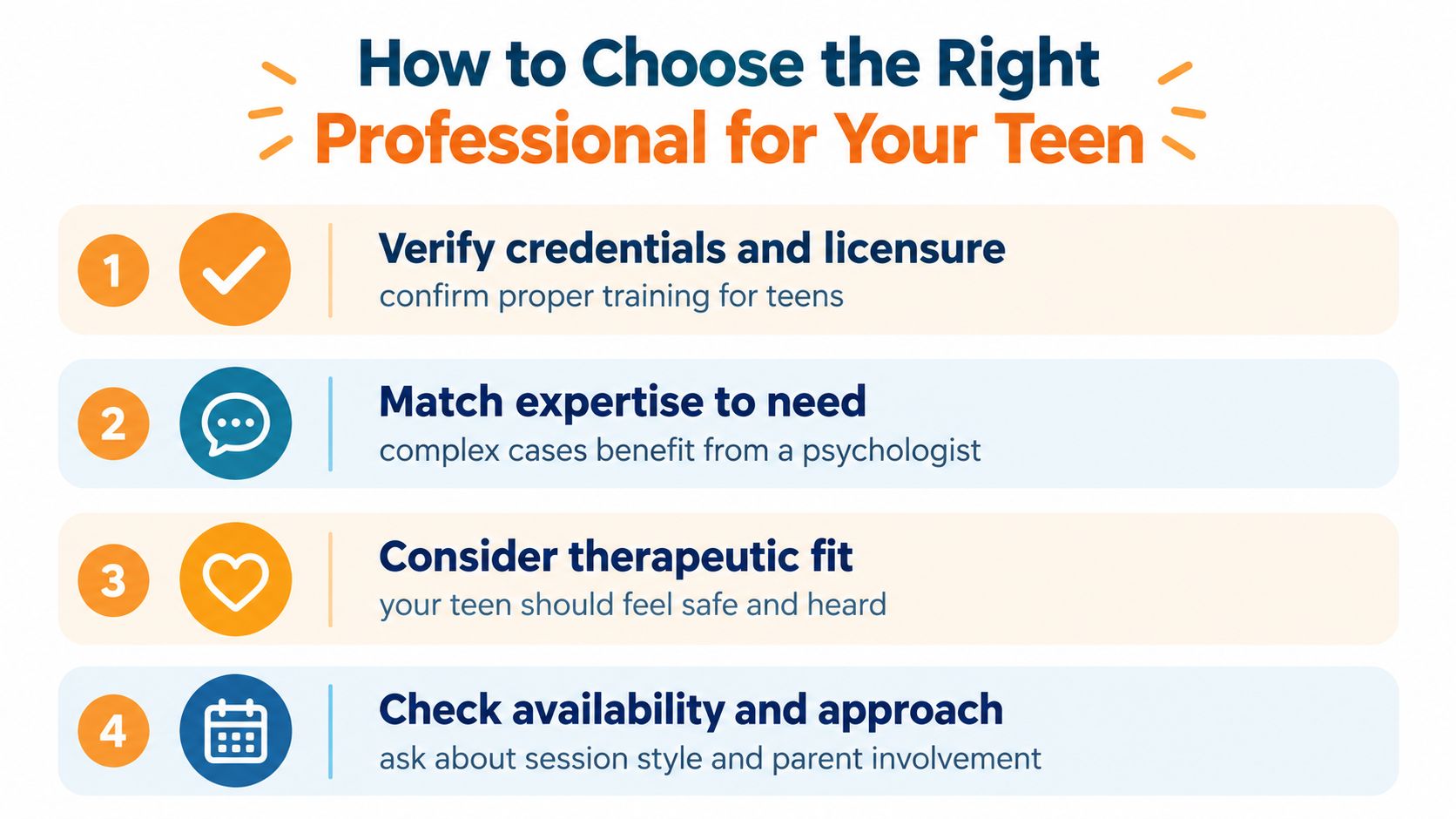
Once you know something is off, the next step is figuring out where to begin. It helps to describe the problem in concrete terms. Instead of only saying, “My teen seems depressed,” try to identify what you are actually seeing. Have they stopped going to school? Started isolating? Become more irritable? Mentioned self-harm? Lost interest in things they used to enjoy?
These details help determine whether your teen may benefit most from outpatient therapy, a fuller psychological evaluation, or a more urgent safety assessment.
Match the professional to the presenting need
A psychologist may be the right first call when the situation is especially complex. That may include major diagnostic uncertainty, suspected learning or neurodevelopmental differences, severe anxiety mixed with depression, or the need for formal testing.
A licensed counselor may be a strong starting point for ongoing support with depression, school stress, bullying, trauma symptoms, grief, family conflict, or coping skill development. If you are looking for practical weekly therapy, counseling for teenagers in Katy, TX can offer a place to start.
Different therapy approaches may fit different situations. CBT can help teens notice patterns of hopeless or distorted thinking. Trauma-focused approaches such as EMDR or ART may be helpful when difficult experiences are central to the depression, assuming the clinician is trained and the teen is ready for that work.
The Value of Specialized and Integrated Care Models
Teen depression often does not travel alone. A teenager may also be dealing with trauma, family conflict, panic, school avoidance, attention difficulties, or emotional dysregulation. When treatment focuses only on sadness, families can miss the patterns that are keeping the depression going.
That is where specialized and integrated care can help. Instead of treating one symptom in isolation, the goal is to create a plan that accounts for the teen's emotional world, family system, school functioning, and any related mental health concerns.
Katy Teen & Family Counseling is one example of a practice serving teens, young adults, families, and couples. Its licensed clinical team addresses depression, anxiety, trauma, ADHD, autism spectrum-related needs, school stress, and relationship difficulties. Services include CBT, EMDR, ART, family therapy, group therapy, and in-house neurofeedback, selected according to the client's development, symptoms, and family circumstances.

Match the model to the clinical picture
Imagine a teen whose depression includes poor sleep, trauma-related nightmares, and frequent conflict at home. A good treatment plan might include individual therapy to address hopeless thinking, family sessions to improve communication, and other supportive tools when appropriate. The important part is that the plan connects directly to what is happening in real life.
Individual counseling gives teens room to talk about things they may not be ready to share at home. Family counseling can reduce conflict, improve trust, and help parents respond more effectively. If family stress is a major piece of the puzzle, family counseling in Katy, TX may be a helpful part of the process.
Neurofeedback is a non-invasive service some practices offer to support focus, sleep, and emotional regulation. It should not replace psychotherapy, medical evaluation, or crisis care. Families should always ask how a service fits the broader treatment plan and how progress will be reviewed.
Coordinate care when needs exceed one discipline
Sometimes a teen needs more than one kind of support. An integrated practice can make it easier to coordinate therapy, psychological testing, psychiatric consultation, medical evaluation, or school communication when needed.
Families exploring remote psychiatric support can review how telepsychiatry works for anxiety and consider whether virtual care fits their teen's needs, privacy concerns, and ability to engage.
Specialized care does not guarantee a specific outcome. What it can do is make it easier to match support to the actual problem and adjust more quickly if the first plan is not enough.
Taking the First Steps Toward Healing
If you are worried about your teen, start with one calm conversation. Pick a neutral time, not the middle of an argument or a moment when emotions are already high. Focus on what you have noticed rather than assigning labels.
You might say, “You have not seemed like yourself lately. I have noticed you are sleeping differently, pulling back from friends, and looking overwhelmed. I would like to help you find support.”
That approach tends to lower defensiveness and make counseling feel like support instead of punishment.
When possible, offer some choice. Let your teen help choose the therapist, decide whether a parent joins the first session, or share whether in-person or virtual sessions feel easier. Collaboration does not remove the parent's responsibility to act when safety is at risk, but it often increases buy-in for non-crisis care.
About the Author

Jason Drake, LCSW, is a licensed clinical social worker who works with teens, young adults, and families in the Katy area. Parents looking for therapy for teens in Katy, TX, counseling for teens in Katy, TX, or young adult counseling in Katy, TX often seek out his practice for support with anxiety, depression, trauma, school stress, panic, bullying, and relationship struggles.
Jason is Board Certified in Neurofeedback as an Associate Fellow, EMDR trained, and a Certified Brain Health Professional through the Amen Clinics. Since 2003, he has helped teens, young adults, and families navigate emotional and behavioral challenges, and he serves as Owner and Lead Clinician at Katy Teen & Family Counseling and Katy Counseling for Men.
In addition to direct clinical work, Jason supports high-performing therapy teams focused on teen therapy, young adult counseling, and family counseling. He also provides coaching and technical support to teen residential treatment centers nationwide and contributes regularly to mental health publications. Readers can explore more of his work on the Featured Articles page.
He has been featured on Fox 26 Houston and has appeared on podcasts including Grow a Group Practice, Let's Talk With Jennifer B, and Marketing Matters.
If you are ready to begin counseling, the next step can be simple.
Katy Teen & Family Counseling provides teen, young adult, and family counseling for anxiety, depression, trauma and PTSD, panic, school stress, bullying, and relationship concerns, along with in-house neurofeedback and approaches including CBT, EMDR, and ART. If these issues are affecting your family's daily life in the Katy or Houston area, visit Katy Teen & Family Counseling to learn about services and request support.


Comments