
8 Grounding Techniques for Teens That Work

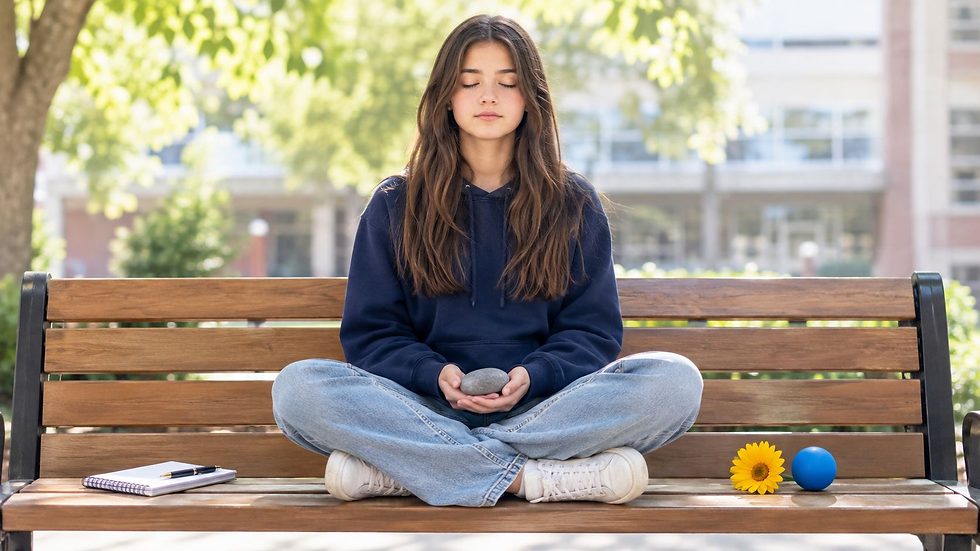
A test is about to start, your chest feels tight, and every sound in the classroom seems too loud. You can't leave without drawing attention, but you need something that brings you back to the desk, the floor, and the next manageable step. That is where grounding techniques for teens can help.
Grounding techniques are short-term coping skills that help teens reconnect with the present moment, their body, or a safe relationship. They can be especially useful during anxiety, panic attacks, school stress, dissociation, emotional overwhelm, or sensory overload. They are not a cure for panic, trauma, depression, dissociation, or self-harm urges, and they should not replace professional mental health care.
For many families, the goal is simple: help a teen get through the moment safely and regain enough control to take the next step. That might mean finishing a test, asking for help, getting through a social situation, or calming down after a conflict.
Research on mindfulness-based interventions suggests that present-moment skills can support teens with anxiety, although results vary. A 2019 meta-analysis of 33 adolescent studies found improvements in self-reported mindfulness, depressive symptoms, and anxiety symptoms, while another review of 18 youth studies found no statistically significant overall effect, with a combined effect of 0.013 and a 95% confidence interval from −0.102 to 0.128. The practical takeaway is clear: grounding can help, but it is not universal. (Adolescent mindfulness meta-analysis)
If your teen struggles with panic, shutdowns, school anxiety, or emotional dysregulation, professional support can help identify which tools actually fit their needs.
Table of Contents
1. The 5-4-3-2-1 Sensory Grounding Technique - Make the sequence discreet
3. Grounding Through Physical Movement and Bilateral Stimulation - Keep the rhythm comfortable
4. The Grounding Box and Sensory Kit Technique - Build it around sensory preferences
5. Cold Water Exposure and Temperature-Based Grounding - Safety comes before intensity
6. Mindful Grounding Through Focused Object Observation - Replace evaluation with description
7. Grounding Through Weighted Items and Deep Pressure Stimulation - Let the teen control the pressure
8. Grounding Through Visualization and Guided Imagery - Imagery isn't right for everyone
Why Grounding Techniques Matter for Teens
Teenagers often experience stress differently than adults. Anxiety may show up as irritability, shutdowns, body tension, panic, avoidance, emotional outbursts, racing thoughts, or difficulty concentrating. In some cases, a teen may not even say they are anxious. They may simply say they feel "off," overwhelmed, trapped, numb, or like they cannot think clearly.
That is why grounding techniques can be so useful. They give teens something concrete to do when emotions feel too big, too fast, or too confusing. Grounding does not have to be complicated. The best techniques are often simple, repeatable, and realistic enough to use at school, at home, in therapy, or in public.
When grounding tools are paired with therapy, they can become part of a bigger treatment plan for anxiety, trauma, panic attacks, ADHD-related dysregulation, school stress, and emotional overwhelm. Families looking for teen counseling in Katy, TX or anxiety therapy for teens often want both practical coping skills and a deeper understanding of what is driving the distress.
1. The 5-4-3-2-1 Sensory Grounding Technique
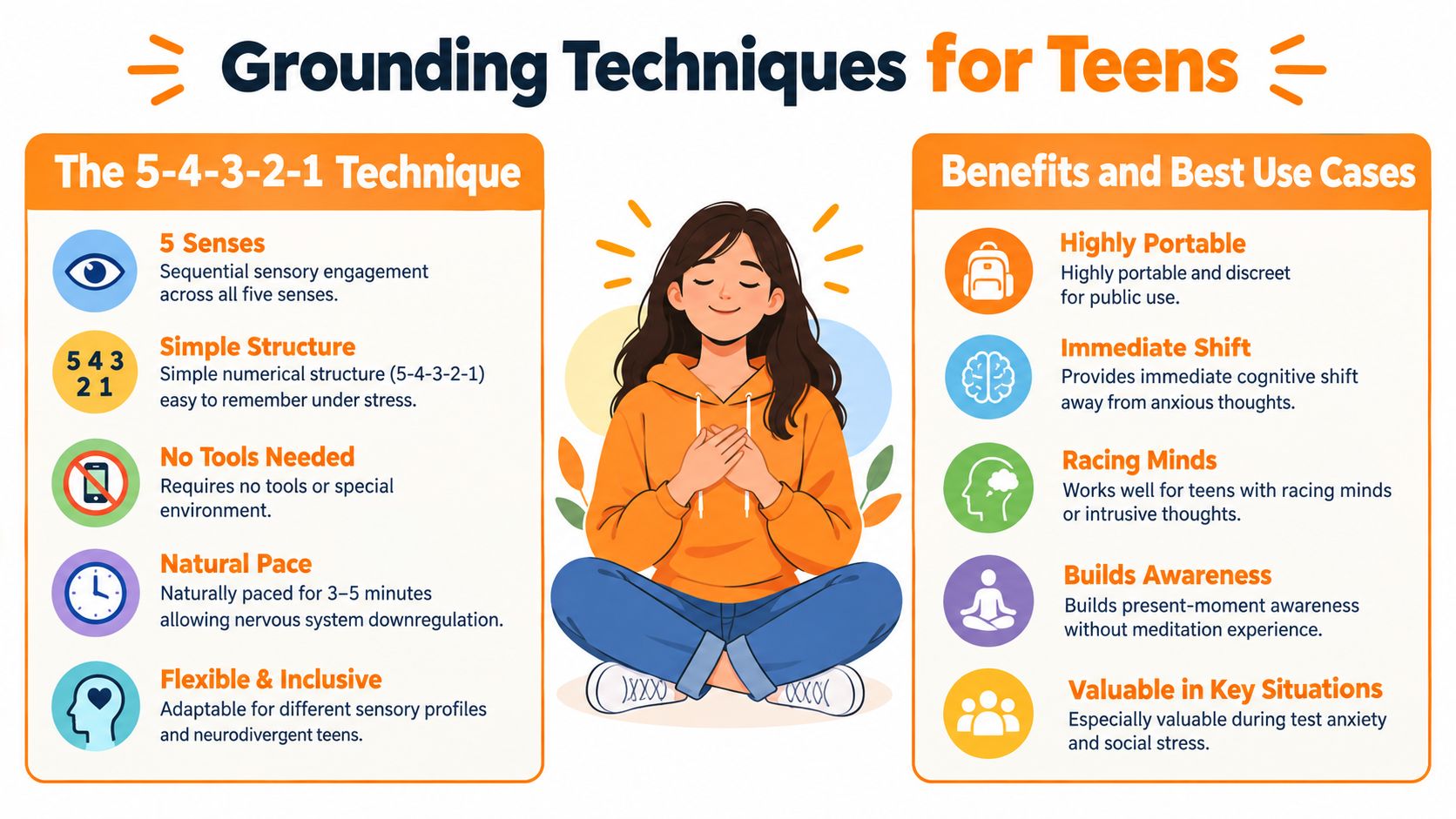
The 5-4-3-2-1 method gives an anxious or dissociated teen a simple sequence to follow: identify five things you can see, four things you can feel or touch, three things you can hear, two things you can smell, and one thing you can taste. The counts move attention away from an internal spiral and toward observable details in the current environment.
Oxford Health CAMHS describes the exercise as a way to redirect attention from overwhelming anxiety, intrusive thoughts, or memories toward the present surroundings and physical sensations. A teen might notice the pattern on the ceiling, the pressure of shoes against the floor, a distant conversation, laundry detergent, and the taste in their mouth. (Oxford Health CAMHS grounding guidance)
Make the sequence discreet
This technique can fit a classroom, car, bedroom, or social setting. During test anxiety, a student might silently notice the desk edge, pencil, classroom lights, and marker smell. At a party, a teen caught in social anxiety can identify the room's colors, the floor beneath their shoes, nearby voices, and the taste of a drink.
Royal Berkshire NHS Foundation Trust recommends beginning with slow breathing through the nose and a slow exhale through the mouth. Its guidance also offers a tactile variation, such as holding keys, a watch, a bracelet, or another object and noticing its texture, temperature, weight, and color. (Royal Berkshire sensory grounding instructions)
Practical rule: Specific observations work better than vague labels. “The desk has a rough edge and a blue ink mark” gives attention more to do than “I see a desk.”
A teen does not have to force a difficult sense. If smell or taste feels unpleasant, start with sight or touch, then use a modified order. Kent Community Health NHS Foundation Trust uses a variation with five things to see, four to hear, three to feel or touch, two to smell, and one to taste. The descending structure matters more than memorizing one fixed order. (Kent NHS panic-attack handout)
2. Progressive Muscle Relaxation
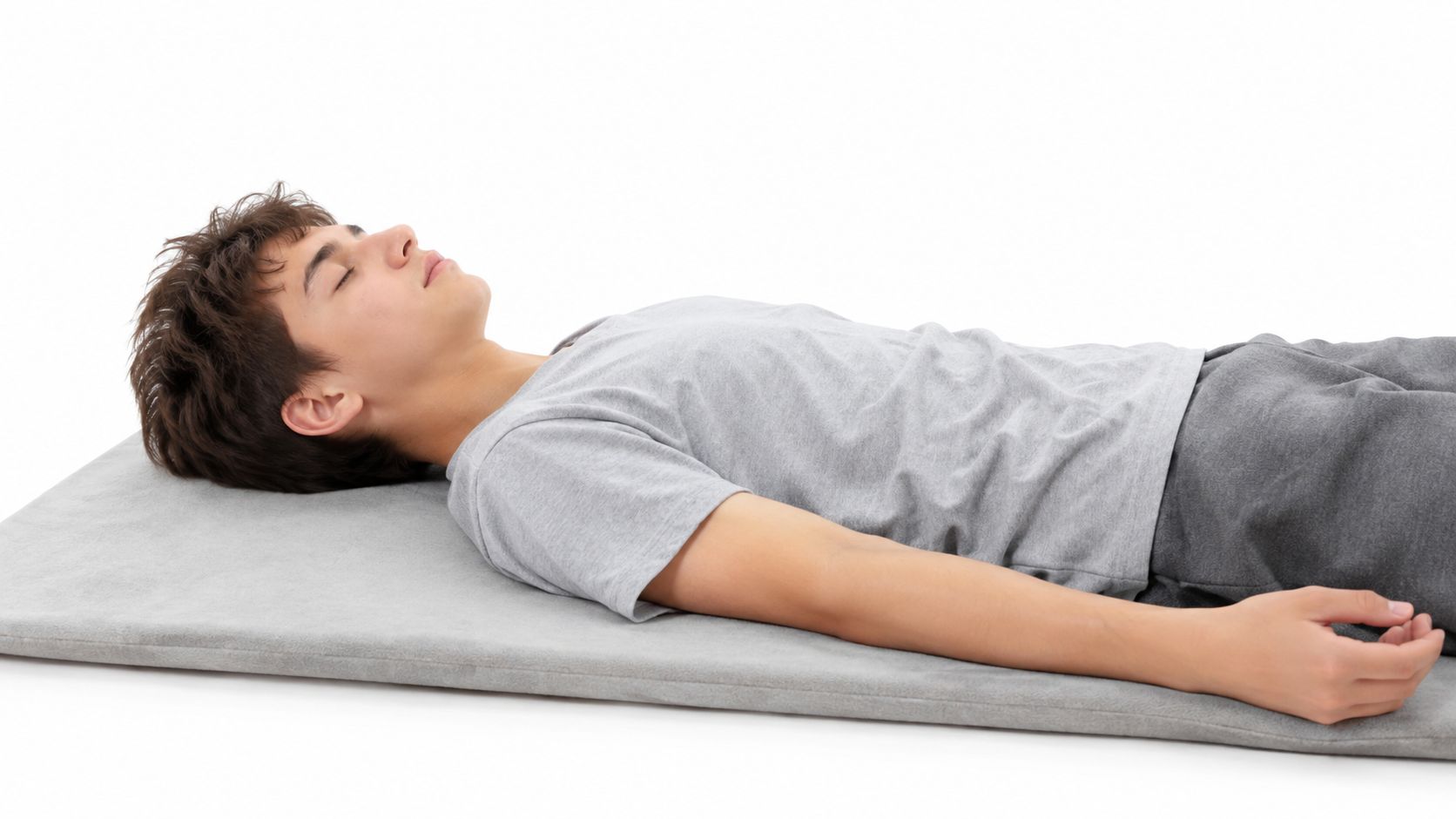
Progressive muscle relaxation, or PMR, uses deliberate contrast. A teen gently tightens one muscle area, notices the sensation, and then releases it before moving to another area. The exercise can begin with the feet and legs, continue through the hands and shoulders, and finish with the face. Its value is practical: it gives a restless body a clear task and helps the teen notice where tension is being held.
PMR may suit a teen whose anxiety shows up as clenched fists, raised shoulders, jaw tension, or an inability to settle at night. A young athlete might use a guided recording before a competition, while a student with school stress might practice a shorter version before sleep. A teen with trauma-related body discomfort may prefer to start with hands or feet rather than focusing on the chest, stomach, or face.
Use less force, not more
The common mistake is treating PMR like a strength exercise. The teen does not need to create intense tension. A gentle squeeze followed by a slow release is enough to explore the contrast. If tightening muscles increases pain, panic, dissociation, or a sense of being trapped in the body, stop and switch to an external strategy such as object observation or orienting to the room.
A guided audio from a therapist or a reputable mindfulness service can reduce the mental effort of remembering each step. Practice during calm periods matters because the sequence is harder to learn in the middle of a panic episode. One brief practice during the week can be more realistic than promising a long routine that the teen will not repeat.
PMR should feel controlled and optional. The teen can stop, open their eyes, move around, or choose a different technique at any point.
Pairing the release with a comfortable exhale may make the exercise easier to follow, but do not frame breathing as a requirement. Some teens become more anxious when they monitor their breathing closely. For them, noticing the chair, floor, or a familiar sound may be a better starting point.
A therapist can help adapt PMR for trauma sensitivity, chronic pain, sensory differences, or sleep problems. The goal is not to make the teen completely calm on command. It is to help them recognize a small difference between bracing and releasing.
3. Grounding Through Physical Movement and Bilateral Stimulation
Stillness is not calming for every teen. Some feel more present when they walk, stretch, tap, or shift their weight. Movement-based grounding uses a steady physical pattern while the teen pays attention to what the feet, hands, knees, or shoulders are doing.
A student with restless energy might alternate tapping their knees under a desk. A teen experiencing hyperarousal after a difficult interaction could walk slowly while noticing the sequence of left foot, right foot, left foot, right foot. Another might squeeze one hand and then the other, or gently tap opposite shoulders. These options can be useful for teens with ADHD-related restlessness, sensory-seeking preferences, or a strong need to move before they can think clearly.
Keep the rhythm comfortable
The movement should be easy to stop and should not cause pain, dizziness, or embarrassment. A discreet option is alternating thumb pressure inside a pocket or tapping each thigh under a desk. At home, walking through a hallway while naming each step can provide more obvious body feedback.
Bilateral movement is sometimes discussed in connection with EMDR, but tapping on its own is not EMDR treatment. A teen receiving EMDR should follow the plan created with their licensed clinician rather than trying to recreate trauma processing independently. Families can read more about EMDR therapy for teens and young adults when considering individualized care.
Choose movement when stillness makes the teen feel less safe. Grounding is supposed to increase connection, not test how long someone can remain motionless.
A focused walk can work well after school, before a difficult conversation, or when thoughts are circling without resolution. Add environmental orientation by naming a building, tree, door, or sound every so often. If walking increases agitation, slow the pace or switch to pressure through the feet while seated.

4. The Grounding Box and Sensory Kit Technique
A grounding box turns preparation into a coping tool. The teen chooses a container and fills it with objects that help them orient, self-soothe, or ask for support. The contents might include a smooth stone, stress ball, textured fabric, gum, a photo, headphones, a written reminder, or a small fidget.
The teen should choose the objects whenever possible. A parent may think lavender is calming, while the teen dislikes scented products. A clinician may suggest a breathing card, while the teen finds written instructions irritating during panic. Personal choice increases the chance that the kit will feel useful rather than imposed.
Build it around sensory preferences
A kit can include several categories, but it does not need to contain every sense. Strong smells can overwhelm a teen with migraine or sensory sensitivity. Food may be inappropriate in class. Headphones may conflict with school rules. A small, policy-compliant version might contain a bracelet, a textured keychain, a photo, and a card with three grounding steps.
Digital tools can support the plan, but they need boundaries. A 2024 survey found that 54% of young people had used a mental-health or well-being app, including 29% who had used meditation or mindfulness apps, 22% who had used stress-reduction apps, and 20% who had used mood-tracking apps. Those figures measure app use, not whether a teen practices grounding during distress, so parents and clinicians should ask what happens after the app is opened. (Hopelab and NORC youth well-being report)
A useful kit includes a short note explaining what each item is for:
Orienting object: A keychain or stone for noticing texture, weight, and temperature.
Connection reminder: A photo or card naming a trusted adult to contact.
Simple instruction: A prompt such as “feet on floor, name the room, text for help.”
Sensory boundary: A reminder to put away any item that increases distress.
In a pilot study of a mindfulness mobile app for adolescents ages 14–18, daily in-app response adherence averaged 55%, or 73% after excluding four early dropouts. Another three-week adolescent trial recorded an average of 33.7 exercises per participant, approximately 1.6 exercises per day, with 83% completing at least 21 exercises. These are feasibility benchmarks for reminders and practice, not proof that a particular app reduces symptoms. (Mobile mindfulness intervention study)
If your teen needs support beyond coping tools, family counseling in Katy, TX can help parents and teens create plans that work at home and at school.
5. Cold Water Exposure and Temperature-Based Grounding
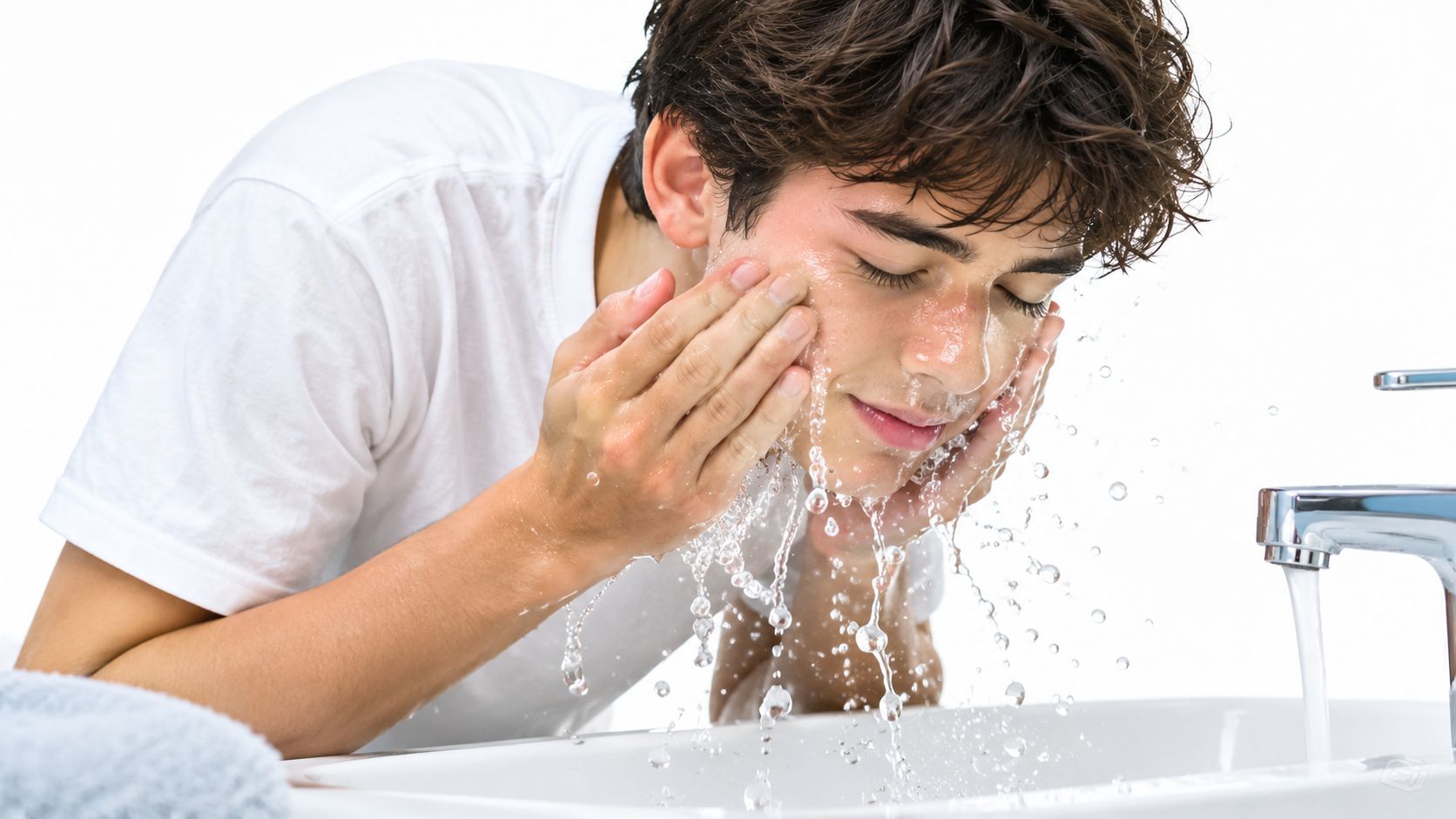
After an argument, panic spike, or emotionally charged moment, a teen may use a bathroom sink to create a clear external sensation. Safer options include holding a cool drink, pressing a cool cloth to the face, or briefly rinsing the hands. The goal is noticeable sensation, not pain, shock, or escalation.
Cool water on the face can trigger the mammalian dive reflex, an automatic response that may slow the heart rate within seconds. This change can interrupt the physical momentum of panic, which is why a cool cloth may help some teens shift faster than verbal reassurance alone. The response varies, and it should not be presented as a treatment for panic or another mental health condition.
A teen might rinse their hands after an argument, then return to slower breathing or name objects in the room. Another may hold a chilled object while identifying the room and the date. Temperature can redirect attention from racing thoughts, but cold may feel threatening to teens with trauma histories, migraines, sensory sensitivities, or a history of using pain to regulate.
Safety comes before intensity
Avoid extreme cold, prolonged exposure, face submersion, breath-holding, or placing ice directly on the skin. Grounding should never involve freezing, injury, punishment, or forcing a teen to continue after distress increases. A teen with a medical condition, fainting history, breathing problem, or significant sensory sensitivity should discuss temperature-based strategies with a qualified professional.
A long-term adolescent mindfulness review supports realistic expectations for mindfulness programs, not proof that cold-water grounding works. The same limit applies here: cold can serve as a brief interrupt, while ongoing panic, dissociation, or distress may require assessment and broader support.
Stop if cold makes the teen feel more frightened, numb, or driven to intensify the sensation. A neutral object, gentle movement, or trusted person may provide a safer anchor.
Temperature grounding fits best as one short option in a prepared plan. Afterward, choose a concrete next step, such as sitting near a parent, texting a counselor, drinking water, or moving to a quieter room. In school, a cool drink or damp cloth may be easier to use discreetly than face washing. For sleep, cold stimulation may be too activating, so a quieter pressure or imagery technique may fit better.
6. Mindful Grounding Through Focused Object Observation
Object observation is a quieter form of sensory grounding. The teen chooses one object, such as a leaf, stone, plant, bracelet, or piece of fabric, and studies it without trying to judge it as attractive or unattractive. They can notice edges, colors, temperature, weight, texture, reflected light, and small marks.
This option can suit a teen who is ruminating but does not want a highly active exercise. A student preparing for a presentation might examine a smooth stone while waiting. A teen experiencing burnout might look closely at a plant and describe its leaves. A young person in therapy might use a neutral object when focusing directly on internal body sensations feels unsafe.
Replace evaluation with description
“Pretty” and “weird” are judgments. “Cool, slightly ridged, pale green, and heavier on one side” keeps attention with observable information. The teen can breathe normally and return to the object whenever thoughts pull them away.
A timer can provide structure, but it should not turn the exercise into a performance. If the teen becomes more detached, bored, or distressed, they can stand up, look around the room, or contact someone. Mindfulness is not forcing attention to stay in one place when the nervous system is signaling that a different approach is needed.
The best object is one the teen likes enough to handle and neutral enough that it does not carry a painful memory.
Object observation often works better as a practice skill than as the only response to a severe panic episode. During acute activation, a teen may need movement, a trusted adult, or a simpler instruction first. Once the intensity drops, the object can help maintain present-moment attention.
7. Grounding Through Weighted Items and Deep Pressure Stimulation
Some teens regulate through pressure. They may feel more organized when sitting under a comfortable blanket, holding a weighted stuffed animal, using a lap pad, or wearing a snug but nonrestrictive layer. Deep pressure can provide a clear boundary around the body, which may feel reassuring when the environment seems chaotic.
This approach can be relevant for teens who seek strong tactile input, including some autistic teens and teens with ADHD-related regulation challenges. It can also help a student remain seated during homework or give a teen a familiar physical anchor during a counseling session. The response is individual, however. Pressure that calms one teen may feel confining or threatening to another.
Let the teen control the pressure
Never place a weighted item on a teen who cannot remove it independently. Do not cover the face or restrict breathing, and do not use pressure as a restraint. Start with a light handheld or lap item, ask how it feels, and stop if the teen becomes hot, uncomfortable, panicked, or unable to move freely.
A school-friendly option might be a small lap pad used with permission. At home, a favorite blanket or stuffed animal may be more acceptable than a specialized product. Families considering support for attention and regulation can review ADHD coping skills and treatment options, particularly when sensory needs affect school, sleep, or relationships.
The goal is not to make a precise claim about hormones or guarantee better sleep. Weighted items are comfort tools, and their usefulness should be judged by the teen's response. Does the teen stay connected? Can they breathe and move easily? Do they return to homework, conversation, or rest more successfully?
Offer pressure as a choice, never as a correction. “Would you like the lap pad?” supports autonomy. “You need this because you're overreacting” can increase shame.
A clinician or occupational therapist can help families consider sensory preferences, physical safety, and whether pressure is appropriate. The item should complement, not replace, treatment for anxiety, trauma, depression, sleep problems, or self-harm risk.
8. Grounding Through Visualization and Guided Imagery
Visualization uses an internal scene rather than an object in the room. A teen might imagine a beach, forest, bedroom corner, or entirely invented place and describe what they see, hear, smell, feel, and taste there. The exercise can offer a mental route away from immediate emotional intensity, especially when the teen has practiced the scene while calm.
A therapist may guide the teen through a safe-place exercise, or the teen may record a short audio using their own words. One student might imagine sitting under a familiar tree before a presentation. Another might picture a quiet room with a door they can open or close. The details should belong to the teen, not the parent or therapist.
Imagery isn't right for everyone
Some teens struggle to form pictures in their minds. Others find internal imagery triggering, especially when memories, body sensations, or imagined scenes feel unpredictable. A teen who becomes more detached should switch to external orientation, movement, or contact with a trusted person.
Instead of insisting on a detailed picture, use a feeling-based prompt: “What would a little safer feel like?” The answer might be warmth in the hands, a steady sound, a familiar phrase, or the sense of sitting near someone trustworthy. Keep the exercise grounded in the current moment by ending with the teen naming where they are and what they will do next.
A personalized recording can include pauses, permission to stop, and reminders that the teen is in control. Avoid language that promises absolute safety or tells a teen to ignore real danger. Visualization is a regulation bridge, not trauma processing by itself.
A teen with trauma symptoms may need a clinician to help develop imagery carefully. If a scene brings up flashbacks, shame, or stronger dissociation, end the exercise and orient to the room. Grounding guidance for young people should include multiple options because sensory sensitivities and trauma responses vary. A review of digital mental health interventions for people ages 16–25 found mindfulness or breathing in 51.9% of interventions and psychoeducation in 71.9%, with many outcomes showing only small-to-moderate benefits. (Youth digital mental-health intervention review)
Teen Grounding Techniques: 8-Method Comparison
Technique | Implementation complexity | Resource requirements | Expected outcomes | Ideal use cases | Key advantages |
|---|---|---|---|---|---|
The 5-4-3-2-1 Sensory Grounding Technique | Low, simple steps, quick to learn | None, no materials or prep | Immediate present-moment shift, short-term anxiety reduction | Panic attacks, test anxiety, public settings | Portable, discreet, easy to remember |
Progressive Muscle Relaxation (PMR) | Moderate, guided practice improves effect | Quiet space, 5-20 min, optional audio | Reduces muscle tension, improves sleep and regulation | Bedtime routines, chronic tension, therapy sessions | Direct somatic regulation, evidence-based |
Bilateral Movement (tapping/walking) | Low to moderate, easy movements but needs focus | Minimal, space to move, optional guidance | Lowers hyperarousal, aids emotional processing | ADHD, restlessness, kinesthetic teens | Integrates movement with processing, discreet options |
Grounding Box / Sensory Kit | Moderate, requires setup and personalization | Items across senses, small cost | Personalized soothing, boosts coping repertoire | Home, therapy, portable school version | Highly personalized, therapeutic to create |
Cold Water / Temperature Grounding | Low, simple action but needs safety screening | Access to cold water or ice, safety planning | Very rapid physiological interrupt of panic | Acute panic, dissociation, intense hyperarousal | Fast-acting, minimal cost |
Mindful Object Observation | Low, simple but requires attention practice | Small object, quiet setting, optional timer | Builds mindfulness, reduces rumination over time | Depression, rumination, sustained attention practice | Gentle, low-pressure, pairs with journaling |
Weighted Items / Deep Pressure Stimulation | Low, easy to use after purchase | Weighted blankets, lap pads, handheld items | Sustained nervous system regulation, comfort support | Sensory processing needs, sleep issues, trauma-sensitive teens | Passive, long-duration calming |
Visualization and Guided Imagery | Moderate, benefits with guided practice | Quiet space, optional recorded guidance | Creates internal calming imagery, reduces anxiety with practice | Anxiety prep, therapy resource-building, sleep | Portable mental resource, supports trauma prep |
How to Build a Grounding Plan for Your Teen
A grounding plan works best when it is created during a calm moment, not invented in the middle of panic. The teen and a trusted adult can choose one fast tool, one movement-based option, and one connection step. Write the plan in the teen's own language, keep it accessible, and review it after real use.
For class, 5-4-3-2-1 or discreet alternating taps may be practical. A student can press both feet into the floor, identify neutral objects, or tap each knee under the desk. The plan should include what to do if the teacher notices, such as asking for a bathroom break, visiting the counselor, or showing a prearranged card.
For acute panic, a teen might begin with a familiar sensory count or a mild temperature cue, then move to slower breathing, water, and contact with an adult. The aim is not to erase every symptom. It is to regain enough regulation to make a safe decision and communicate what is happening.
For dissociation, stillness can sometimes make the teen feel less connected. Movement, object observation, factual orientation, or sitting near a trusted person may work better than focusing intensely on internal sensations. A teen with autism-related sensory sensitivities, migraine, trauma history, or panic should have permission to skip strong scents, loud audio, intense cold, forced eye contact, or other prompts that feel overwhelming.
Practice should be repeated without turning it into homework punishment. A systematic review found that mindfulness-based benefits were more defensible in the short and medium term than as permanent anxiety reduction, and the researchers noted substantial variation between programs and participants. Grounding is more likely to become available during distress when the teen has tried it in ordinary settings and knows which options make things better or worse. (Adolescent mindfulness follow-up evidence)
Track simple observations:
Situation: What happened before the spike?
Starting state: Was the teen panicked, numb, angry, restless, or tired?
Tool used: Which technique did they try?
Immediate response: Did distress decrease, stay the same, or increase?
Next step: Did they return to class, sleep, talk, or seek support?
When to Seek Professional Help
Grounding should not be used to dismiss persistent symptoms. Panic attacks, frequent dissociation, trauma symptoms, depression, self-harm concerns, suicidal thoughts, or daily impairment call for assessment by a licensed clinician. Parents can ask, “Do you need help getting regulated, or do you need me to listen?” A calm relationship is often more useful than insisting on the perfect exercise.
Therapy can help clarify why one grounding technique works in one situation and fails in another. It can also help teens identify patterns, triggers, body signals, and treatment options that go beyond short-term coping tools.
Katy Teen & Family Counseling offers support for teens, young adults, and families through services such as teen counseling, family counseling, EMDR therapy, and other evidence-informed approaches designed to help young people manage anxiety, trauma, school stress, ADHD-related challenges, and emotional overwhelm.
About the Author

Jason Drake, LCSW is a licensed clinical social worker and teen therapist serving Katy, Texas. He works with teens, young adults, and families facing anxiety, depression, trauma, panic, school stress, bullying, relationship challenges, and emotional overwhelm. Families looking for teen therapy in Katy, TX, counseling for teens in Katy, TX, or young adult counseling in Katy, TX often seek out his practice for thoughtful, structured, and compassionate care.
Jason is Board Certified in Neurofeedback as an Associate Fellow, EMDR trained, and a Certified Brain Health Professional through the Amen Clinics. Since 2003, he has helped teens, young adults, and families navigate emotional and behavioral struggles with clarity and support. He serves as the Owner and Lead Clinician at Katy Teen & Family Counseling and Katy Counseling for Men.
In addition to his clinical work, Jason supports high-performing therapy teams focused on teen therapy, young adult counseling, and family counseling. He also provides coaching and technical support to teen residential treatment centers across the country and contributes regularly to mental health publications. Readers can explore more of his work on the Featured Articles page.
He has been featured on Fox 26 Houston and has appeared on podcasts including Grow a Group Practice, Let's Talk With Jennifer B, and Marketing Matters.
If you are ready to begin counseling, the next step can be simple.


Comments