
Overcoming School Refusal: A Comprehensive Checklist for Katy Parents


You've tried the gentle nudges, the firm warnings, and the desperate bargaining, yet the bedroom door remains locked while the school bus pulls away. It's a heavy, isolating silence that leaves you wondering if you're failing as a parent.
You aren't alone in this struggle, and your teen isn't simply being defiant. Whether your child is paralyzed by social anxiety or overwhelmed by academic pressure, the morning battle is often a cry for help that requires a specialized approach to overcoming school refusal therapy.
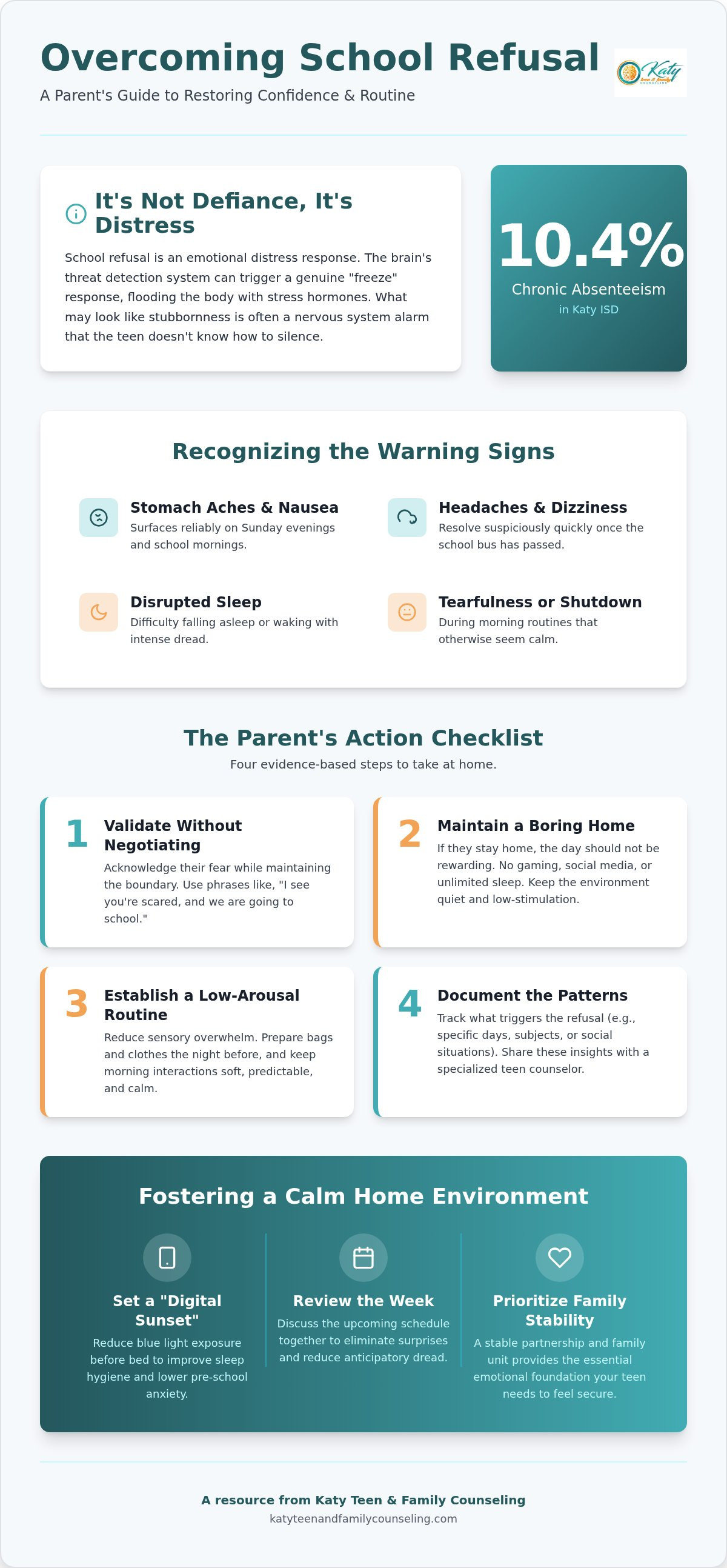
You deserve a path toward peace. This guide provides an actionable, evidence-based framework to help your teen move from morning resistance to classroom confidence. We'll explore root causes, look at Katy ISD's 10.4% chronic absenteeism rate, and outline how specialized teen therapy and parent coaching help your child rediscover their strength.
Table of Contents
Recognizing the Signs and Root Causes of School Refusal
School refusal isn't a character flaw, a parenting failure, or simple rebellion. It's an emotional distress response, and understanding that distinction is the first step toward meaningful change. As Understanding School Refusal on Wikipedia notes, the behavior encompasses a broad spectrum of emotionally driven avoidance that looks very different from typical truancy. For Katy families navigating the pressures of high-achieving academic environments, this distinction carries enormous weight.
The physical signals often appear first. Watch for patterns like these:
Stomach aches and nausea that surface reliably on Sunday evenings and school mornings
Headaches and dizziness that resolve suspiciously quickly once the school bus has passed
Disrupted sleep, including difficulty falling asleep the night before school or waking with intense dread
Tearfulness or emotional shutdown during morning routines that otherwise seem calm
These aren't manipulation tactics. They're the body keeping score of genuine psychological distress, whether rooted in teen anxiety, academic overwhelm, social difficulties, or unresolved trauma and PTSD.
Identifying Anxiety vs. Truancy: Why the Distinction Matters
The anxious avoidant teen and the truant teen look nothing alike on closer inspection. A truant student typically seeks out something more appealing: friends, screens, freedom. The anxious teen stays home, often miserable, trapped in a cycle of relief and guilt. They're not choosing fun over school. They're choosing perceived safety over perceived threat.
This is where the neuroscience becomes clarifying.
When the school bus arrives, a dysregulated amygdala can trigger a genuine freeze response, flooding the body with stress hormones before a single rational thought forms. What reads as defiance during a morning routine is frequently the nervous system sounding an alarm it doesn't know how to silence.
Recognizing this biological reality is foundational to overcoming school refusal therapy, because it shifts the conversation from "why won't you go?" to "what are you so afraid of?" That shift changes everything.
The Parent’s Action Checklist for Overcoming School Refusal
When mornings feel like a battlefield, you need a compass. These moments are incredibly draining, yet your response can either escalate the anxiety or act as a stabilizing anchor. A structured approach is essential when seeking overcoming school refusal therapy, as it bridges the gap between home struggles and clinical progress. By following a predictable framework, you provide the safety your teen needs to face their fears.
Validate without negotiating: Use phrases like, "I see you're scared, and we are going." Acknowledge the intense emotion while maintaining the boundary of attendance.
Maintain a boring home environment: If your teen stays home, the day shouldn't involve gaming, social media, or unlimited sleep. Keep the environment quiet and low-stimulation to ensure home isn't more rewarding than school.
Establish a low-arousal routine: Reduce sensory overwhelm by prepping bags the night before and keeping morning interactions soft and predictable.
Document the patterns: Track what triggers the refusal. Share these insights with a specialized teen counselor to refine your therapeutic strategy.
Creating a Structured and Supportive Home Environment
Family stability starts long before Monday morning. A consistent Sunday routine lowers the collective heart rate of the household and prepares the nervous system for the week ahead. Consider these steps to foster a calm environment:
Set a firm "digital sunset" to reduce blue light exposure, which is critical for healthy sleep hygiene.
Review the upcoming week's schedule together to eliminate surprises and reduce anticipatory dread.
Prioritize the health of the family unit; a stable marriage or partnership provides the emotional foundation your teen needs to feel secure.
If you find yourself stuck in these cycles, our team is here to help you navigate the path back to a calm home. You can reach out to us to begin this journey toward restoration together.
Evidence-Based Therapy for School Refusal in Katy, TX
Clinical expertise and genuine human empathy aren't competing forces. At Katy Teen & Family Counseling , they work in concert. With over 70 years of combined therapist experience and a team hired specifically for teen and family work, this practice brings a depth of specialized understanding that generalist counseling simply can't replicate.
Overcoming school refusal therapy here begins with one foundational belief: your teen's nervous system deserves targeted, precise care, not a one-size-fits-all approach.
Where many practices stop at Cognitive Behavioral Therapy, this team goes further. Neurofeedback trains the brain directly, using real-time feedback to help a dysregulated nervous system learn to self-regulate. EMDR and Accelerated Resolution Therapy (ART) address the root of school-based trauma and social phobia by allowing teens to reprocess distressing memories without extended verbal re-exposure. These aren't supplemental options; they're precision tools for a problem that demands precision.
Families in the Katy area are invited to visit the Grand Reserve Drive office for a collaborative family session, where the goal is a shared roadmap rather than a diagnosis handed across a desk.
Integrating Neurofeedback and CBT for Lasting Success
Neurofeedback for teen anxiety creates the physiological calm that makes CBT's cognitive restructuring actually stick. Think of it this way: you can't teach a teen to challenge anxious thoughts while their amygdala is in full alarm mode. Neurofeedback quiets that alarm first.
Family counseling runs alongside individual teen work to repair the parent-child bond that school refusal often strains. Addressing this now isn't just about attendance; it's an investment in your teen's adult life, preventing the longer-term pattern known as failure to launch before it takes hold.
Neurofeedback: Trains the brain for calmer baseline regulation
CBT: Builds cognitive tools once the nervous system is receptive
EMDR and ART: Resolves underlying trauma driving avoidance
Family counseling: Restores trust and communication within the home
Every step your teen takes toward the school door is a step worth supporting with the right clinical framework. Reach out today to begin building that framework together.
Restoring Your Family’s Peace and Progress
The journey from morning battles to classroom confidence isn't one you have to walk alone. By shifting your perspective from viewing school refusal as defiance to seeing it as a physiological distress response, you've already taken the first step toward healing.
Our approach to overcoming school refusal therapy integrates specialized teen counseling with advanced tools like Neurofeedback to address the root of the anxiety. With over 70 years of combined experience, our specialists at 23410 Grand Reserve Drive, Ste. 401, are dedicated to helping Katy families rediscover their strength.
We invite you to Schedule a Consultation with our Specialized Teen Therapists in Katy. There is a path forward, and your teen has the resilience to find it. Let's start the work of rebuilding your calm morning routine together today.
Frequently Asked Questions
Is school refusal a mental health diagnosis?
School refusal is not a standalone clinical diagnosis in the DSM-5; it is a behavioral symptom of underlying emotional distress. It often signals a primary struggle with social anxiety, generalized anxiety, or depression. Identifying the root cause is the central focus of overcoming school refusal therapy, as we look beyond the avoidance to treat the internal conflict driving the behavior.
How long does it typically take to see progress in school refusal therapy?
Progress timelines vary based on the severity of the avoidance and the presence of co-occurring conditions. While some families notice a shift in morning dynamics within a few weeks, reaching consistent classroom confidence typically requires a dedicated commitment of several months. Our evidence-based approach focuses on sustainable, long-term regulation rather than quick fixes that might lead to future relapses.
Can Neurofeedback help my teen if they also have ADHD?
Yes, Neurofeedback is highly effective for teens navigating both school refusal and ADHD. By training the brain to improve focus and reduce impulsivity, we help calm the "fight or flight" response that often triggers school avoidance. This specialized tool strengthens the brain's ability to self-regulate, making it easier for your teen to manage the sensory and academic demands of the classroom.
What should I do if the school is threatening legal action for absences?
Open communication with school administrators is vital when legal concerns arise. We recommend sharing that your child is actively engaged in a specialized therapeutic plan. Schools are often more collaborative when they see a professional intervention in place. Providing documentation from your therapist can help bridge the gap between attendance requirements and your teen's current teen anxiety needs.
Do you offer online sessions for teens who won't leave the house?
We understand that the intensity of school refusal can sometimes make leaving the house feel impossible. While our Katy office serves as a calm harbor for in-person teen therapy, we can discuss flexible options to begin the engagement process. Our goal is to build enough safety and rapport to eventually transition your teen into our supportive, specialized physical environment on Grand Reserve Drive.
How does parent coaching work alongside my teen's individual therapy?
Family counseling and parent support act as the bridge that brings therapeutic progress into your living room. While your teen works on internal regulation, you will learn specific strategies to maintain a stable home environment and validate their feelings without reinforcing avoidance. This collaborative approach ensures that the entire family system is moving toward the same goal of restoration and classroom return.


Comments