
5 Coping Skills for Teens in Katy, TX: A Parent's Practical Guide


Your teen is in bed the night before a big exam, staring at the ceiling. Her heart is racing, her jaw is tight, and she keeps replaying everything that could go wrong. Telling her to relax does not help. That does not mean she is doing anything wrong. She may need a skill she can practice.
What are good coping skills for teens? Five useful starting points are paced breathing, sensory grounding, thought records, behavioral activation, and naming emotions. Each addresses a different part of stress. A teen whose body feels overwhelmed may start with breathing or grounding. A teen stuck on a frightening prediction may benefit from a thought record later, once she can think clearly.
For parents looking for teen anxiety support in Katy, TX, it helps to know both what to try at home and when to seek professional help. The World Health Organization adolescent mental health fact sheet reports that approximately one in seven adolescents ages 10 to 19 experiences a mental health condition. Coping skills can help, but they are not a substitute for care when symptoms persist or affect safety.
Table of Contents
Which Coping Skill Should Your Teen Try First?
Start with the problem your teen has right now. If stress feels physical, try a slow exhale. If your teen feels disconnected or overwhelmed by the surroundings, try grounding. If a harsh thought keeps returning, save a thought record for a calmer moment. If low mood has led to withdrawal, start with one small planned activity. Naming the feeling can help at any point.
Practice one skill on an ordinary day before relying on it during an exam, a difficult school day, or a family argument. You do not have to hand your teen all five tools at once.
1. Paced Breathing and Cyclic Sighing
Breathing exercises get eye rolls, especially from teens who have tried taking huge breaths during panic and felt worse. Paced diaphragmatic breathing is about slowing down rather than forcing a deep breath. Cyclic sighing gives your teen a simple pattern: inhale through the nose, take a second small sip of air, then let out a longer, gentle exhale through the mouth.
The goal is not to erase anxiety. It is to ease the body's alarm enough to take a useful next step, such as reading the first exam question or asking a teacher for help. For example, a teen heading into an exam at a Katy ISD high school could practice a few gentle exhales before opening the test. They can do the same before a presentation at school, without needing anyone else to notice.

A 2023 randomized study by Melis Yilmaz Balban and colleagues found that a brief daily cyclic sighing practice improved mood and reduced resting respiratory rate over a month compared with the mindfulness meditation practice studied. That does not mean breathing works better for every teen. For someone who wants to build attention skills alongside breathwork, simple everyday mindfulness practices for teens and families can offer another starting point.
This demonstration shows the double inhale and long exhale:
Rehearse when calm. Try a few breaths after brushing teeth so the pattern feels familiar.
Keep the exhale gentle. Forcing air can leave someone lightheaded.
Model rather than command. A parent can practice alongside a teen without insisting that the teen calm down.
Stop if dizzy. Return to normal breathing and choose another skill if this one feels uncomfortable.
Breathing can create a pause. It will not, by itself, resolve an ongoing school, relationship, or mental health problem.
2. 5-4-3-2-1 Sensory Grounding
Imagine your teen standing in a crowded hallway at a Katy ISD school, unable to focus on which classroom comes next. They might quietly notice the color of a locker, the feel of a backpack strap, or a voice nearby. 5-4-3-2-1 grounding directs attention to what is happening around them right now:
Name five things you can see.
Notice four things you can feel.
Identify three things you can hear.
Find two things you can smell.
Notice one thing you can taste.
If a sense is hard to access, skip it or substitute a sip of water. Details such as a scuffed floor tile or the weight of a backpack strap can be more useful than vague answers. This step-by-step guide to using grounding to manage anxiety walks through the same sequence.

Grounding may be especially practical when talking through the problem feels like too much. A teen can quietly name objects on a bus or in a classroom without explaining their feelings to anyone nearby. A school-based study of 1,344 adolescents ages 14 to 18 reported that 43.0% had severe stress and 16.8% had extremely severe stress. Those findings are a reminder to give young people tools they can actually access during the day, not a prediction about any particular teen.
Save the sequence in a phone note and practice it on an ordinary afternoon. During a stressful moment, offer to do it together rather than turning it into a quiz.
3. Thought Records for Stressful Predictions
Breathing and grounding may help your teen settle physically. A thought record addresses the sentence still running through her mind: "Everyone will laugh if I answer in class." A Katy-area teen might have that thought before speaking up in class or after getting a disappointing grade on a quiz. Used in cognitive behavioral therapy, or CBT, a thought record helps them examine the prediction rather than accept it as a fact.
The approach draws on Aaron T. Beck's cognitive therapy, while David D. Burns later popularized a three-column format in Feeling Good. A simple version asks:
Write down | Example |
|---|---|
Situation | The teacher asked for volunteers. |
Feeling and intensity | Embarrassed, 80 out of 100. |
Automatic thought | Everyone will laugh at me. |
Evidence for and against | I stumbled once last week; other students have answered without being laughed at. |
More balanced thought | I might feel awkward, but I do not know how classmates will react. |
A teen can then notice what actually happens over the next few classes. For more examples of unhelpful thought patterns, see common cognitive distortions and coping skills in CBT. A written record can also be easier to review later than a memory of a stressful day; this guide to recording everyday experiences for your future self offers another way to make a manageable writing habit.
Try one record, not a daily homework packet. Ask what your teen might tell a friend in the same situation. If writing feels overwhelming, use a few short prompts or talk through the questions together. Save this skill for after the most intense part of a panic episode has passed.
4. Behavioral Activation for Withdrawal and Low Mood
When a teen feels down, "wait until you feel motivated" can keep them stuck. Behavioral activation starts with a small, scheduled action. Motivation may follow, but the activity does not depend on it.
Suppose a Katy-area teen stopped going to soccer after a difficult month. Returning to every practice may feel impossible. Sending one message to a teammate or taking a 15-minute walk at a nearby park is a smaller first step. They can rate the activity for pleasure and sense of accomplishment afterward, even if neither score changes immediately.
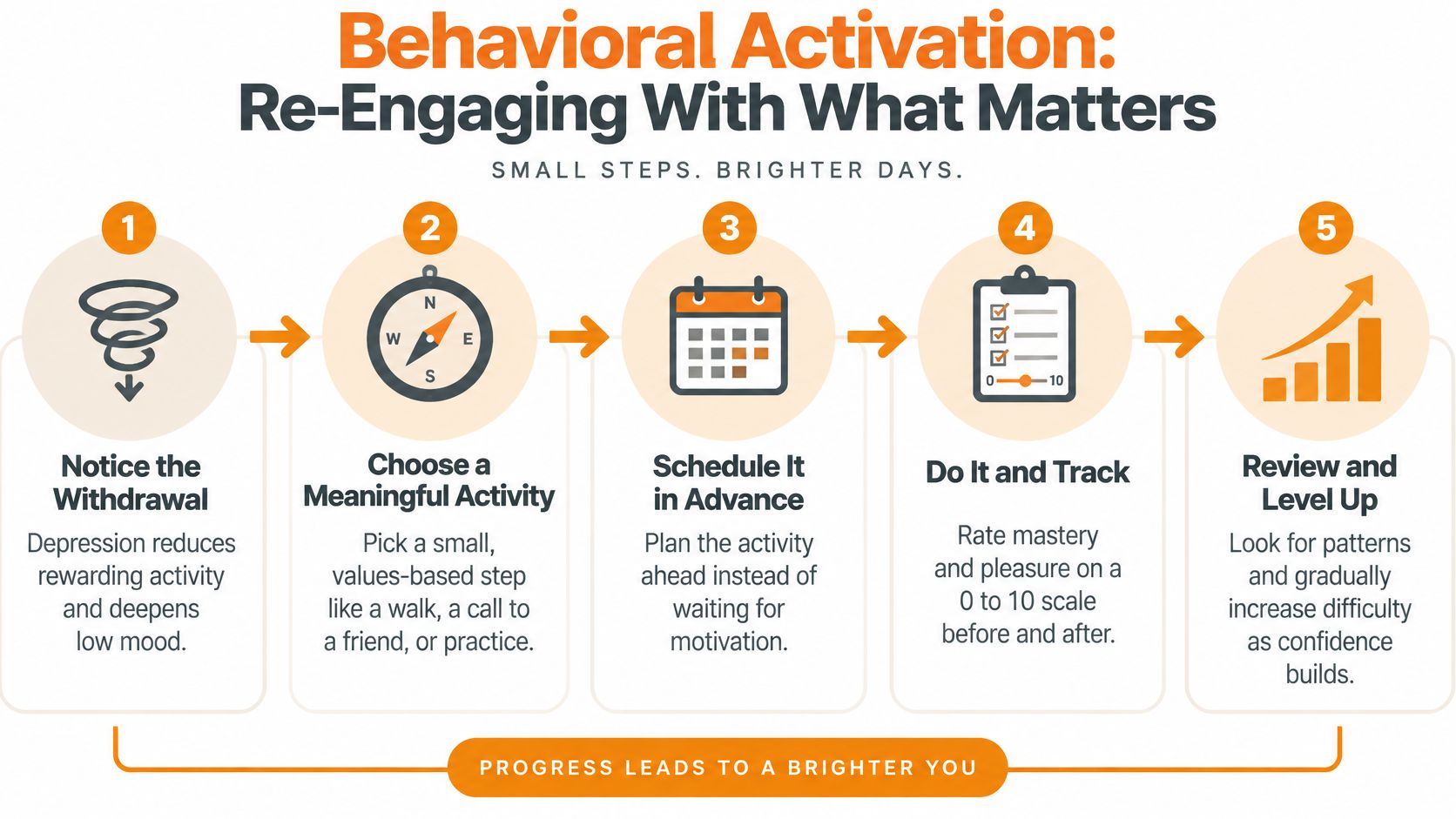
Neil S. Jacobson and colleagues' 1996 study compared components of cognitive therapy for depression, and Christopher Martell, Michael Addis, and Jacobson later described the behavioral activation model in Depression in Context. Planning an activity can sound easy to an adult; doing it while depressed may not feel easy to a teen.
Keep sleep and everyday routines in view, too. The American Psychological Association's guidance on stress in children and teens notes that teenagers need 8 to 10 hours of sleep and cites a recommendation of at least 60 minutes of daily physical activity for ages 6 to 17. Those recommendations are context, not a reason to turn a coping plan into another source of pressure.
Praise the effort, not the mood outcome. If withdrawal or low mood persists, a teen may need an assessment and more support than a home activity plan can provide.
5. Affect Labeling: Name the Feeling
Ask a teen how they feel and you may hear "fine" or "bad." Affect labeling means finding a more precise word: embarrassed, left out, overwhelmed, disappointed. The label does not fix the feeling. It helps your teen decide what might help next.
UCLA researcher Matthew D. Lieberman and colleagues have studied how putting feelings into words relates to the brain's response to emotional stimuli. Dan Siegel and Tina Payne Bryson later popularized the phrase "name it to tame it" in The Whole-Brain Child. The practical idea is straightforward: "I'm embarrassed" suggests a different conversation than "I'm angry."

After a tough school day in Katy, try offering a few choices without deciding for your teen: "Was that more disappointing, lonely, or frustrating?" Listen to the answer before suggesting a solution. A missed invitation or an awkward exchange with a teammate may call for a different conversation than stress about an assignment. A 2025 UNICEF report on Gen Z mental health found that only half of Gen Z respondents believed their coping mechanisms were effective, while 52% reported stigma in schools or workplaces. A teen needs a safe person to speak with, and that person may sometimes be a counselor, coach, teacher, or another trusted adult.
The parent move: Stay curious. Your teen gets to decide whether the word fits and what they want to share next.
5 Coping Skills at a Glance
Skill | Best starting point for | A practical first step |
|---|---|---|
Paced breathing and cyclic sighing | Physical signs of stress | Practice a gentle double inhale and long exhale when calm. |
5-4-3-2-1 sensory grounding | Feeling overwhelmed or disconnected | Name details you can see, feel, hear, smell, and taste. |
Thought records | Repeating fearful or self-critical predictions | Write down one thought and consider evidence for and against it. |
Behavioral activation | Withdrawal and low mood | Schedule one small, meaningful activity. |
Affect labeling | Feelings that are hard to explain | Replace "bad" with a more specific emotion word. |
When to Seek Teen Counseling in Katy
Coping skills are a starting point, not a test your teen has to pass. Consider reaching out to a licensed clinician if anxiety or low mood keeps disrupting sleep, school, relationships, or everyday activities.
Seek prompt professional guidance for escalating panic, trauma symptoms, or self-harm concerns. If there is immediate danger or suicidal thinking, use emergency or crisis services rather than waiting to try another coping exercise.
Katy Teen & Family Counseling serves Katy and the greater Houston area. Its practice information describes support for teens, young adults, and families; its verified services include teen therapy, young adult counseling, family therapy, group therapy, marriage counseling, and neurofeedback. If you are unsure where to start, ask how the team could help your family choose an appropriate next step.
You can also call or text 281-519-6364 or email info@katyteenandfamilycounseling.com with questions. The practice offers private-pay options and does not accept insurance; its therapists are considered out-of-network providers by insurance companies.
Frequently Asked Questions
What is the easiest coping skill for a teen to try at school?
A discreet grounding exercise or a gentle, longer exhale can be a manageable first step. The best option is the one your teen has practiced and feels comfortable using in that setting.
Can coping skills replace therapy for teen anxiety?
No. Coping skills can support a teen between difficult moments, but persistent symptoms, impairment at school or home, or safety concerns call for professional evaluation. Families seeking teen counseling in Katy can ask a clinician which skills fit their teen's needs.
How can parents help without taking over?
Offer to practice one skill together, ask what felt useful, and let your teen choose whether to keep using it. If a skill does not help, treat that as information rather than a failure.
Where can families in Katy find support for teens and young adults?
Katy Teen & Family Counseling provides teen therapy, young adult counseling, and family therapy for clients in Katy and the greater Houston area. Call or text 281-519-6364 to ask about support.
If you want a printable prompt for practicing at home, find coping resources for big emotions and choose just one skill to work on first. Research on adolescent coping described in this European Child and Adolescent Psychiatry article also highlights the value of social support. Your teen does not need to handle every hard moment alone.
If stress, anxiety, or family conflict is disrupting your teen's sleep, schoolwork, or relationships, Katy Teen & Family Counseling offers teen, young adult, and family therapy in Katy and the greater Houston area. Reach out to discuss what kind of support may fit your family.


Comments