
Conflict Resolution Therapy for Couples and Families


The argument starts over a kitchen table like many others in Katy, TX. One partner asks about a purchase, the other hears criticism, and within minutes they are debating money, respect, parenting, and every unresolved disagreement since last month. In another home, a parent knocks on a teenager's door, the teen says "leave me alone," the parent raises their voice, and the door slams again. The words change, but the pattern is familiar.
Conflict resolution therapy helps couples and families change that pattern. It does not try to prove who is right or eliminate disagreement. Instead, it helps people recognize the cycle they keep entering, regulate the reactions that intensify it, and respond in a healthier way. Research supports couple and family therapy, but the right approach depends on the relationship pattern, the people involved, and whether the situation is safe for joint work.
In brief: Conflict resolution therapy helps couples, parents, and teens interrupt recurring arguments, improve communication, and repair conflict without causing more damage to the relationship.
In this article: You'll learn how conflict resolution therapy works, which therapy models are commonly used, when joint sessions are appropriate, and what kind of results couples and families can realistically expect.
Table of Contents
What Conflict Resolution Therapy Actually Targets - The cycle matters more than the courtroom
The Main Therapy Models Used in Conflict Work - Emotionally Focused Therapy - Cognitive-Behavioral Therapy - Systemic Family Therapy - The Gottman Method - Solution-Focused Brief Therapy
What Happens in Your First Month of Sessions - The early work has a measurable shape
When Conflict Resolution Therapy Is Not the Right First Step - What a responsible intake examines
Realistic Results and How to Take the First Step - What progress may look like
When the Same Argument Keeps Coming Back
A couple may arrive convinced they are fighting about money. One says the other spends impulsively. The other says every purchase gets monitored. In session, the therapist may find that the spending dispute is only the visible part of a faster cycle: one partner feels shut out and presses harder, the other feels controlled and withdraws, and that withdrawal confirms the first partner's fear of being ignored.
The same process appears in parent-teen conflict. A parent sees unfinished homework and pushes for an explanation. The teenager experiences the questions as pressure, gives short answers, and retreats. The parent follows, the teen escalates, and both leave the interaction believing the other person caused it.
A recurring argument usually contains two problems: the stated issue and the interaction pattern that turns the issue into a threat.
Conflict resolution therapy slows that pattern down without forcing a verdict about who is right. Therapists listen for criticism, defensiveness, withdrawal, shutdown, escalation, and repair. Those behaviors often form a loop that runs faster than either person's intentions. The goal is practical. Therapy can help people interrupt the sequence, name the underlying need, and repair before resentment hardens.
What Conflict Resolution Therapy Actually Targets
Conflict resolution therapy is structured treatment that changes how people respond to conflict, not just the topic they are arguing about. Money, chores, sex, grades, boundaries, and screen time may be the subject, but the deeper clinical target is usually the interaction pattern underneath.
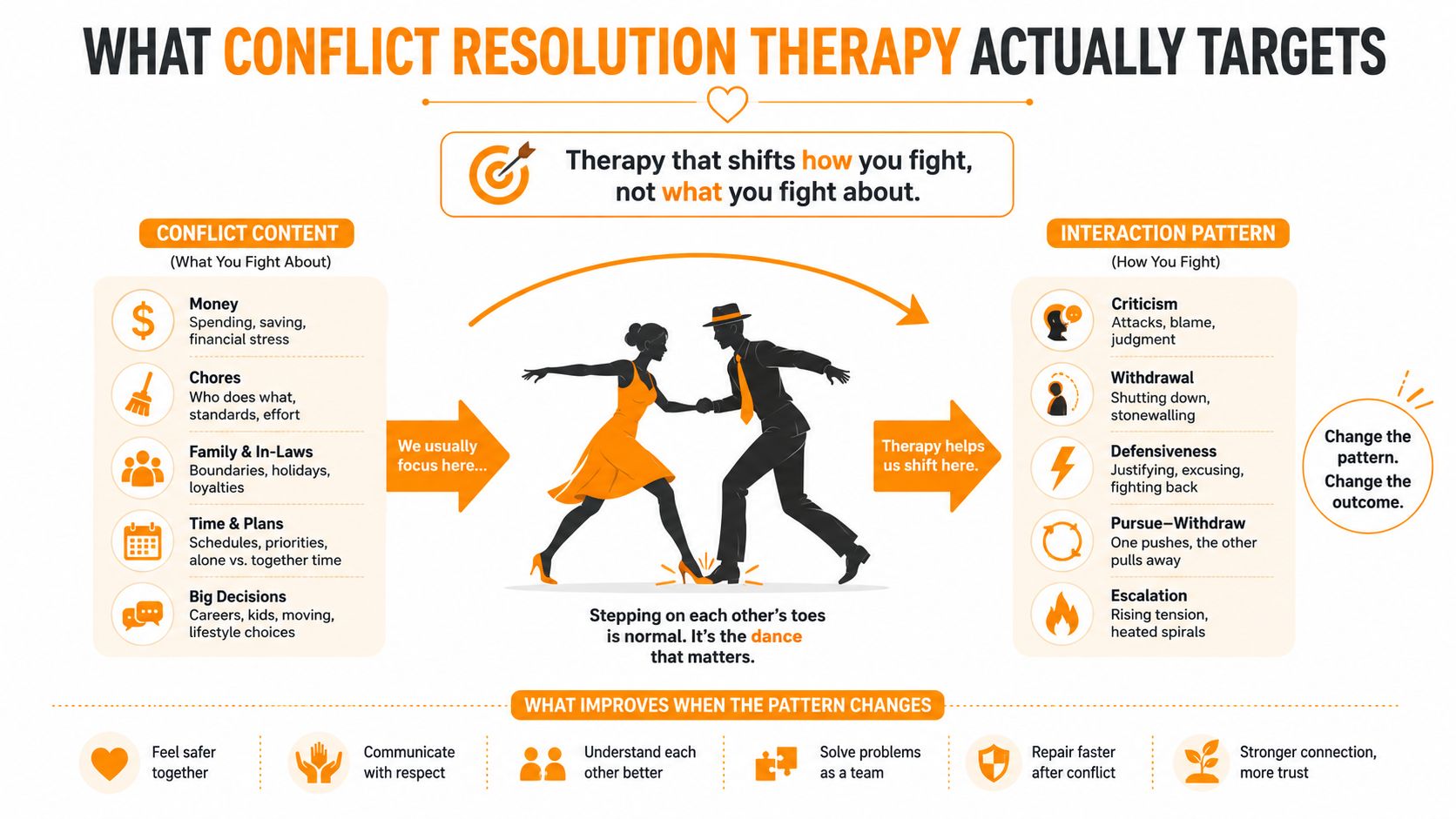
Think of two dancers who keep stepping on each other's feet. The music changes, but the choreography does not. One moves forward, the other backs away, the first speeds up, and the second turns away. A therapist watches the sequence rather than arguing about whether the music was the original problem.
The cycle matters more than the courtroom
Therapists track what each person does and what that action evokes in the other person. A complaint can trigger defensiveness. Defensiveness can trigger louder criticism. Louder criticism can produce silence, sarcasm, or walking away. Treatment makes that chain visible so each person can identify their own part in it.
The work often includes emotional regulation, because communication skills rarely work when the nervous system is overwhelmed. It may also include speaker-listener exercises, reflective listening, cognitive restructuring, and planned pauses. A pause is not avoidance. It is a temporary boundary that lets both people return with enough control to hear and respond.
The same principle applies outside couples work. People who need more guidance around communication and workplace differences may benefit from resources on conflict resolution for autistic employees, especially when sensory, processing, or communication needs shape the interaction.
The aim is greater safety, clearer emotional expression, fewer automatic reactions, and more reliable repair after a rupture. Practical active-listening exercises can support that process and help couples slow down reactivity during hard conversations.
The Main Therapy Models Used in Conflict Work
No single model fits every couple or family. A therapist may begin with one framework and borrow techniques from another after identifying whether the core issue involves attachment fear, distorted thinking, family hierarchy, emotional flooding, or a need for focused short term change. If you are comparing options for marriage counseling and couples therapy or family counseling, it helps to understand what each model is designed to change.
Emotionally Focused Therapy
Emotionally Focused Couples Therapy, or EFCT, works with attachment needs and the cycle partners create when they feel rejected, unsafe, or alone. The therapist helps each person move beneath anger or withdrawal and express the more vulnerable emotion driving the reaction. It often fits pursue-withdraw patterns and emotional disconnection. For a method overview, see the International Centre for Excellence in Emotionally Focused Therapy.
A 2026 clinical review reports 70% to 75% recovery rates for couples with significant relationship distress and measurable improvement in about 90% of couples by the end of treatment, with gains sustained in two year follow-up assessments. The review of marriage therapy success rates provides that outcome context.
Cognitive-Behavioral Therapy
Cognitive-Behavioral Therapy, or CBT, focuses on the relationship between interpretations, emotions, and behavior. CBT helps clients test assumptions and practice different behaviors. For a clinical overview of CBT principles, visit the Beck Institute.
It is often useful when conflict is maintained by mind-reading, all-or-nothing thinking, hostile attribution, avoidance, or poor problem-solving. CBT can be delivered individually, with a couple, or within family work.
Systemic Family Therapy
Systemic family therapy treats the household as an interconnected system. The therapist looks at roles, boundaries, rules, alliances, and communication patterns rather than focusing on one identified problem person. This model fits conflict that spreads across several relationships. The American Association for Marriage and Family Therapy offers a helpful overview.
A 2024 review of 28 studies found that several systemic approaches outperformed treatment as usual for up to 2.5 years after therapy ended, with an average effect of d = 0.24. The average family-therapy case also fared better than 58% to 59% of treatment-as-usual or alternative-treatment cases across outcomes such as family functioning, scholastic achievement, antisocial behavior, drug use, and deviant peer contact. The review of evidence-based family therapy details those findings.
The Gottman Method
The Gottman Method uses structured assessment and skills training to address friendship, emotional responsiveness, conflict management, and recurring gridlocked problems. It often fits couples who want concrete exercises and a shared vocabulary for turning toward each other rather than escalating. You can learn more from the Gottman Institute.
Solution-Focused Brief Therapy
Solution-Focused Brief Therapy emphasizes preferred outcomes, existing strengths, exceptions to the problem, and small observable changes. It may suit families facing a defined transition or couples who need a focused behavioral goal, such as creating a calmer parenting handoff or agreeing on how to pause arguments. For a concise overview, the Solution Focused Universe explains the core ideas behind this approach.
A skilled clinician blends models. The choice should follow the pattern in the room, not the therapist's attachment to one brand of therapy.
Model | Core Focus | Best Fit For |
|---|---|---|
Emotionally Focused Therapy | Attachment needs and emotional cycles | Couples caught in pursuit and withdrawal |
Cognitive-Behavioral Therapy | Thoughts, emotions, and behaviors | Conflict shaped by assumptions, avoidance, or reactivity |
Systemic Family Therapy | Roles, boundaries, and family interaction | Parent-teen, sibling, and household conflict |
Gottman Method | Friendship, communication, and repair | Couples seeking structured relationship skills |
Solution-Focused Brief Therapy | Specific goals and existing strengths | Defined problems requiring focused change |
What Happens in Your First Month of Sessions
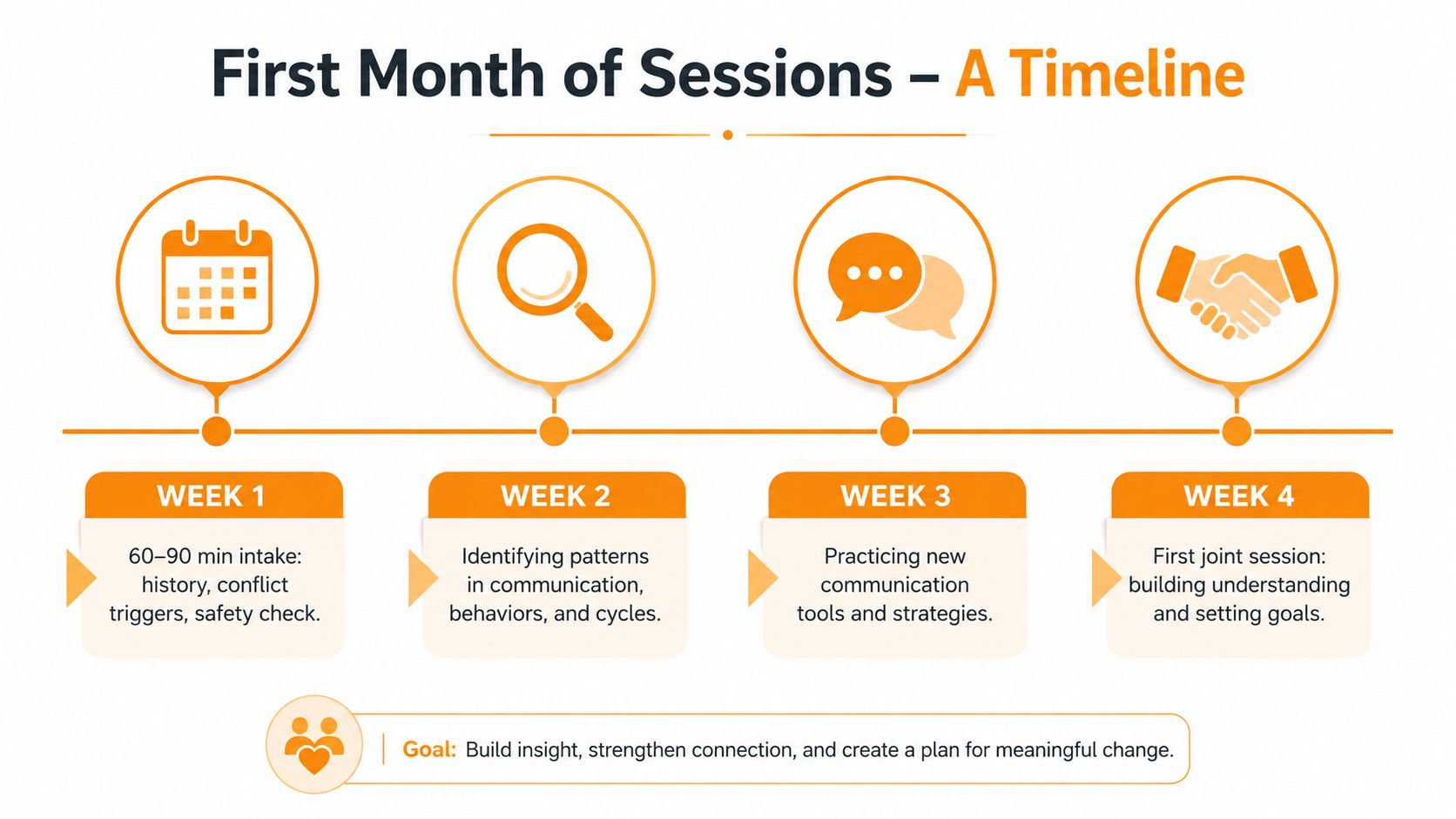
The first month should feel active, but not forced. A careful therapist begins by understanding the history of the relationship, the current triggers, previous attempts to solve the problem, and any safety concerns. An intake may last 60 to 90 minutes, depending on the practice and the complexity of the situation.
The early work has a measurable shape
Rather than accepting “we need to communicate better,” the therapist should help define two or three concrete goals. Those might include fewer explosive arguments, faster repair after a rupture, a clearer voice for the quieter family member, or more consistent parenting responses.
Early sessions may introduce:
Speaker-listener structure: One person speaks about one topic while the other reflects what they heard before responding.
Emotion beneath the complaint: “You never help” may become “I feel alone and afraid I am carrying this by myself.”
A planned pause: When escalation reaches about 7 out of 10, either person can request a break with a clear return plan.
The point is to make the old sequence observable and create space for a new response.
The therapist may assign a brief check-in, a repair-attempt log, or one written reflection about a difficult interaction. Progress often becomes visible between sessions first.
The therapist should also explain what happens if one person cannot participate safely or consistently. Joint work is not automatically the correct format, and the plan may change as new information emerges.
Choosing Individual, Couples, Family, or Group Work
The right format depends on who is affected by the conflict and whether the pattern is primarily internal, relational, or systemic.
Format | Best Fit For | Typical Session Length | When to Skip It |
|---|---|---|---|
Individual | Personal trauma, regulation, readiness, or changing one's own role | Varies by clinician and treatment plan | When the central problem requires coordinated family change and individual work alone will not address it |
Couples | A committed pair whose interaction loop drives the distress | Varies by clinician and treatment plan | When joint discussion increases danger or coercive control |
Family | Parent-teen, sibling, or household patterns | Varies by clinician and treatment plan | When key participants cannot engage or safety concerns remain unresolved |
Group | Skills practice, psychoeducation, and peer learning | Varies by program and group structure | When privacy, acute instability, or individualized care needs make group work unsuitable |
Individual therapy can help when one partner is not ready, when trauma is driving intense reactions, or when a person wants to change their own role before inviting others in. Couples work fits when the cycle between partners is central. Family therapy is often best when the conflict moves through the whole household. Group work can be useful for practice, psychoeducation, and shared learning.
When Conflict Resolution Therapy Is Not the Right First Step
Before teaching active listening, a clinician must ask whether the home is safe enough for both people to speak. Standard conflict resolution assumes that each person can tolerate discomfort, hear the other perspective, and choose not to retaliate. Coercive control and abuse undermine those assumptions.
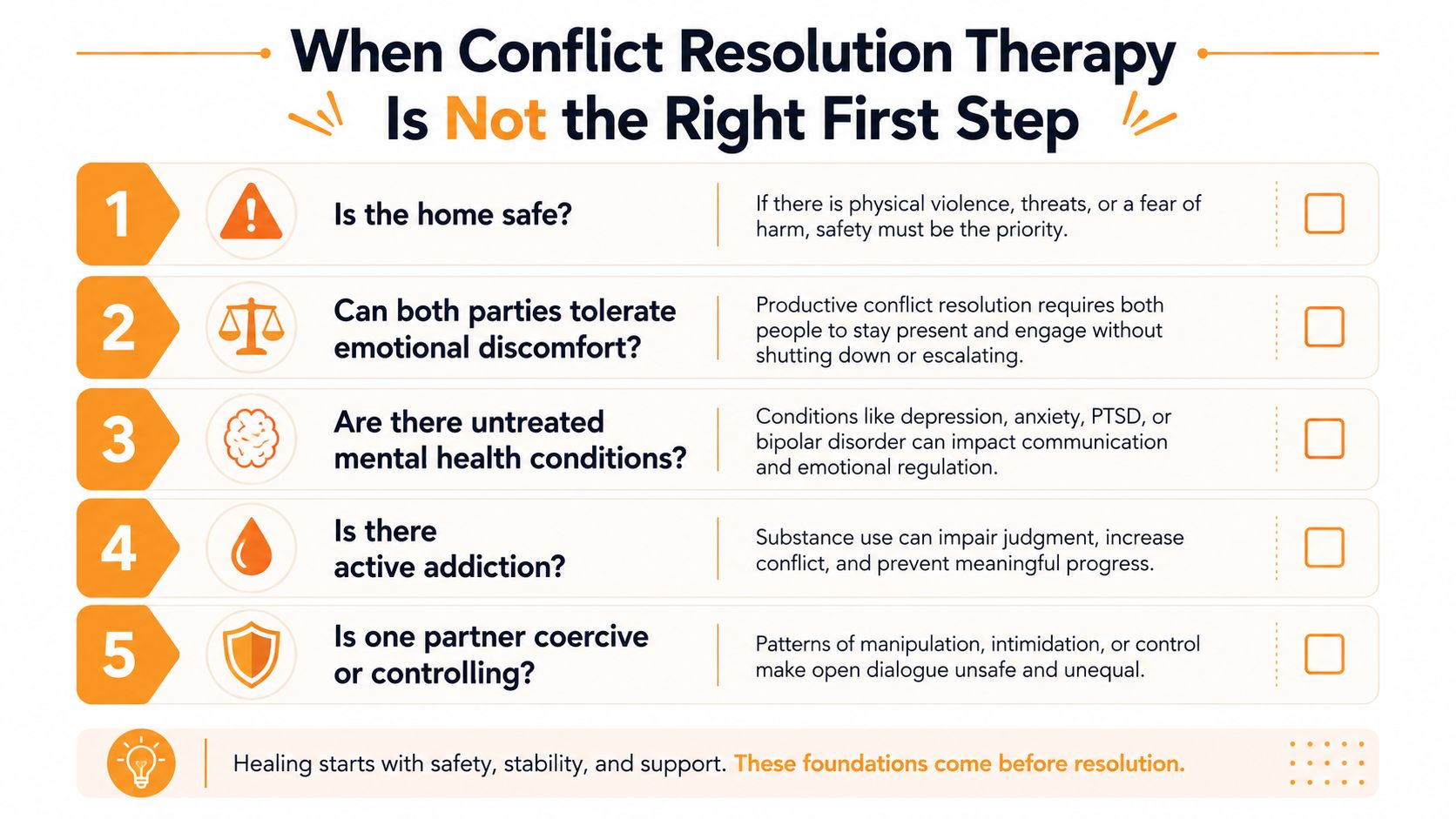
Joint dialogue may be unsafe when there is active domestic violence, coercive control, untreated substance use, or active psychosis. Asking a victim to communicate more calmly with a controlling partner can shift responsibility toward the person at risk. Requiring disclosure in front of someone who monitors, threatens, or punishes them can also increase danger after the session ends.
What a responsible intake examines
A therapist may ask whether anyone fears the other person, whether someone controls money or movement, whether threats or physical violence have occurred, and whether a person can disagree without consequences. They may also assess intoxication, withdrawal, severe mood symptoms, psychosis, self-harm risk, access to weapons, and the safety of children or dependent adults.
These questions are not an accusation. They help determine whether treatment should be joint, individual, parallel, or paused.
When the ground is not stable, the clinician may prioritize individual safety planning, trauma-focused treatment, substance-use care, psychiatric evaluation, or referral to a domestic violence program. The appropriate response depends on the risk and the available local resources.
Safety changes the treatment plan. Pausing joint conflict work is often the correct clinical decision.
The clinical discussion of approaches to conflict resolution highlights why relationship-preserving methods should not be treated as the first move in every situation. A therapist should be willing to say that communication training is not appropriate yet, adapt the format, or recommend another level of care.
Realistic Results and How to Take the First Step
Conflict resolution therapy can produce noticeable changes without creating a conflict-free home. Some couples notice less escalation within 6 to 8 sessions, while deeper changes may require 3 to 6 months of consistent work. Readiness, safety, severity, attendance, and therapist fit all affect the pace.
A 2022 review reports that the average person receiving couple therapy is better off at termination than 70% to 80% of people not receiving treatment, with meaningful short term gains in relationship satisfaction. The same review notes that relapse or deterioration still occurs for roughly 35% to 50% of couples at 2 years or more after treatment, which makes follow-up skills important. The review in PMC provides that longer-term context.
What progress may look like
A familiar disagreement may return during a move, job loss, illness, or another family transition. That does not automatically mean therapy failed. Progress may look like noticing the trigger sooner, lowering the intensity, taking a defined pause, returning when promised, and repairing without reopening every old injury.
Meta-analytic evidence also supports change beyond general satisfaction. A 2020 review found a large pre-to-post improvement in relationship satisfaction, Hedges g = 1.12, compared with Hedges g = 0.12 for waitlist controls, and reported benefits in communication, emotional intimacy, and partner behavior that were generally maintained at follow-up. The evidence-based family therapy summary connects those findings to specific skills such as turn-taking, repair attempts, and reducing demand-withdraw patterns.
Katy Teen & Family Counseling offers individual, couples, family, group, trauma-focused, and neurofeedback services for teens, young adults, parents, and couples working through conflict and emotional regulation concerns in Katy, Texas. If recurring arguments, parent-teen tension, or relationship distress are affecting your home, visit Katy Teen & Family Counseling to review services and take the next step toward a treatment plan that fits your situation.
Article by

Jason Drake, LCSW, BCN-L
Jason Drake is a Licensed Clinical Social Worker, Board Certified in Neurofeedback, EMDR trained, and a Certified Brain Health Professional through the Amen Clinics. He has worked with teens, young adults, and families since 2003 and serves as Owner and Lead Clinician at Katy Teen & Family Counseling and Katy Counseling for Men.
He specializes in supporting high performing therapy teams focused on teen therapy, young adult counseling, and family counseling. Jason also provides expert coaching and technical assistance to teen residential treatment centers across the country and regularly contributes to mental health publications. You can explore more of his work on the Featured Articles page.
He has also appeared on Fox 26 Houston and podcasts including Grow a Group Practice, Let's Talk With Jennifer B, and Marketing Matters.
If you are ready to start counseling, contact us today.

Comments