
How Does Neurofeedback Therapy Work? A Katy, TX Parent's Guide


If your teen struggles to settle at bedtime, stay focused on homework, or manage stress, anxiety, social anxiety, panic attacks, ADHD, depression or other challenges, you may be wondering: How does neurofeedback therapy work? In simple terms, sensors measure brain activity while a screen or sound gives immediate feedback. With repeated practice, your teen gets opportunities to work toward a selected brainwave pattern.
At Katy Teen & Family Counseling, families in Katy and the greater Houston area can explore neurofeedback alongside counseling tailored to their teen's needs. Here is what the process looks like and what to ask before starting.
How Does Neurofeedback Therapy Work?
Neurofeedback is a form of EEG biofeedback. Sensors placed on the scalp detect electrical activity; they do not send electricity into the brain. A clinician chooses a training target, and software responds to the measured signal in real time.
Imagine your teen watching a video that becomes clearer when the chosen brainwave activity reaches its target and dims when it moves away. That quick response is the feedback. Over many short rounds, the teen practices responding to the changing cues without having to consciously control each brainwave.
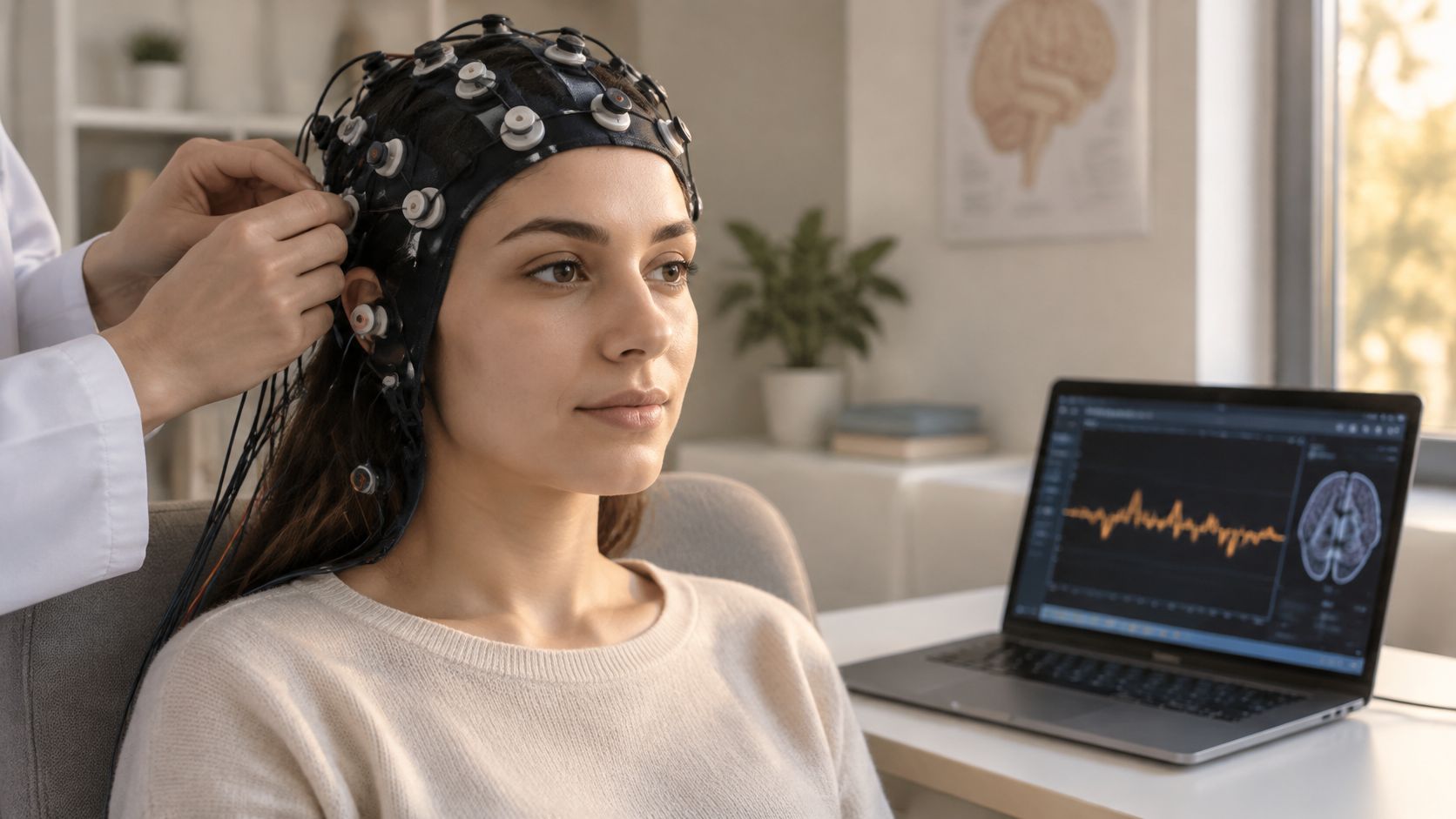
The feedback loop has four parts:
Measure: EEG sensors record the activity being trained.
Compare: Software checks that activity against the selected target.
Respond: A game, video, or sound changes immediately.
Repeat: The teen practices across multiple rounds and visits.
The practice's neurofeedback therapy in Katy, TX page explains the two approaches it offers: amplitude training with selected sensors and Z-score training that uses a 19-sensor cap for brain mapping.
Which Brainwaves Are Trained?
A brainwave frequency describes how quickly a rhythm cycles. Its amplitude describes the strength of that rhythm. Your teen's training target depends on the clinician's assessment and the reason for seeking care.
Brainwave rhythm | General association | Example training goal |
|---|---|---|
Theta | Drowsiness and inward attention | Practice reducing excess slow activity during attention training |
Alpha | Relaxed wakefulness | Practice a calmer state |
Sensorimotor rhythm (SMR) | Calm alertness and stillness | Practice maintaining steady attention |
Beta | Active thinking | Practice attention-related patterns, depending on the protocol |
You may hear a clinician describe a goal as "SMR up, theta down." That is a shorthand for the rhythms the training is designed to reinforce. Because protocols differ, ask which rhythms are being trained and why they were chosen for your teen.
The 2024 review of EEG and fMRI neurofeedback studies discusses how participants learn to modulate measured brain activity. For an accessible explanation of deep-sleep rhythms, see this guide to slow-wave sleep.
What Happens at a Neurofeedback Session in Katy?
A visit generally begins with a conversation about your teen's goals, followed by sensor setup, a brief baseline check, several training rounds, and a check-in afterward. The clinician can adjust the target as your teen trains.
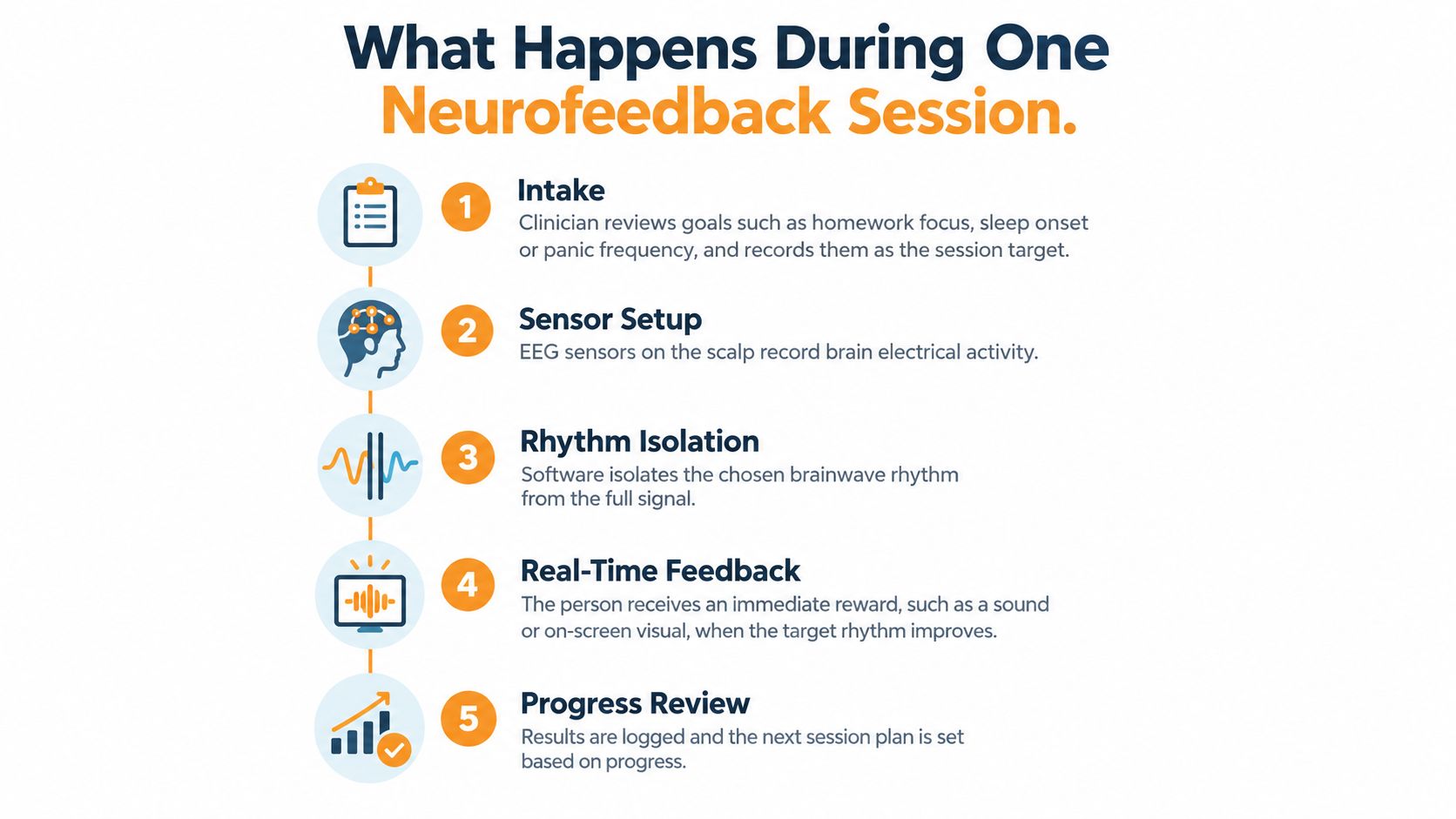
Your teen might watch an animation, listen to music, or follow a game while the feedback responds to the EEG signal. This short video offers a look at the session experience:
If you are considering an assessment first, read the practice's explanation of qEEG neurofeedback for teenagers. Before your teen begins, ask what the training will target, how the clinician will review progress, and how the plan fits with any care already in place.
How Can Families Track Progress?
Neurofeedback uses repeated practice, so families often find it helpful to choose a goal they can notice outside the session. A teen might track homework completion, time needed to fall asleep, or how often anxiety disrupts a school morning.

Think of it like practicing balance on a bike: progress is easiest to recognize when you know what you are working on and check in over time. If you would like a general introduction to spaced practice, MasteryMind's guide to spaced repetition explains the concept. The 2024 ADHD neurofeedback review from King's College London is also useful background if you want to discuss how studies measure outcomes.
A practical starting point is to choose one or two goals, record where things stand now, and agree with your clinician on when to review them.
Why Do Katy Families Ask About Neurofeedback?
Parents often ask about neurofeedback for teens when they are exploring support for attention, anxiety, trauma-related stress, or sleep. The training plan can be discussed in the context of the teen's broader mental health care.
Concern | A goal to discuss with the clinician | Everyday measure |
|---|---|---|
Attention and ADHD | Training related to focus and regulation | Homework completion or school feedback |
Anxiety and panic | Training related to calmer regulation | Frequency of difficult mornings or panic episodes |
Trauma-related stress | Training related to arousal and sleep | Sleep diary or daily stress rating |
Sleep difficulties | Training related to settling at night | Time needed to fall asleep |
For school-related questions, this ADHD and learning disabilities explainer can help parents think separately about classroom support. You can also read the practice's review of neurofeedback for teenagers before your consultation.
Clinical research explores neurofeedback across several conditions. Families interested in trauma can read this review of randomized PTSD neurofeedback studies. When talking with a provider, focus on your teen's individual goals and how those goals will be reviewed.
Neurofeedback and Teen Counseling Can Work Together
A neurofeedback session focuses on practicing regulation with real-time feedback. Counseling gives teens space to talk through school stress, relationships, emotions, and difficult experiences. At Katy Teen & Family Counseling, families can ask how teen counseling in Katy and neurofeedback might fit into one coordinated care plan.
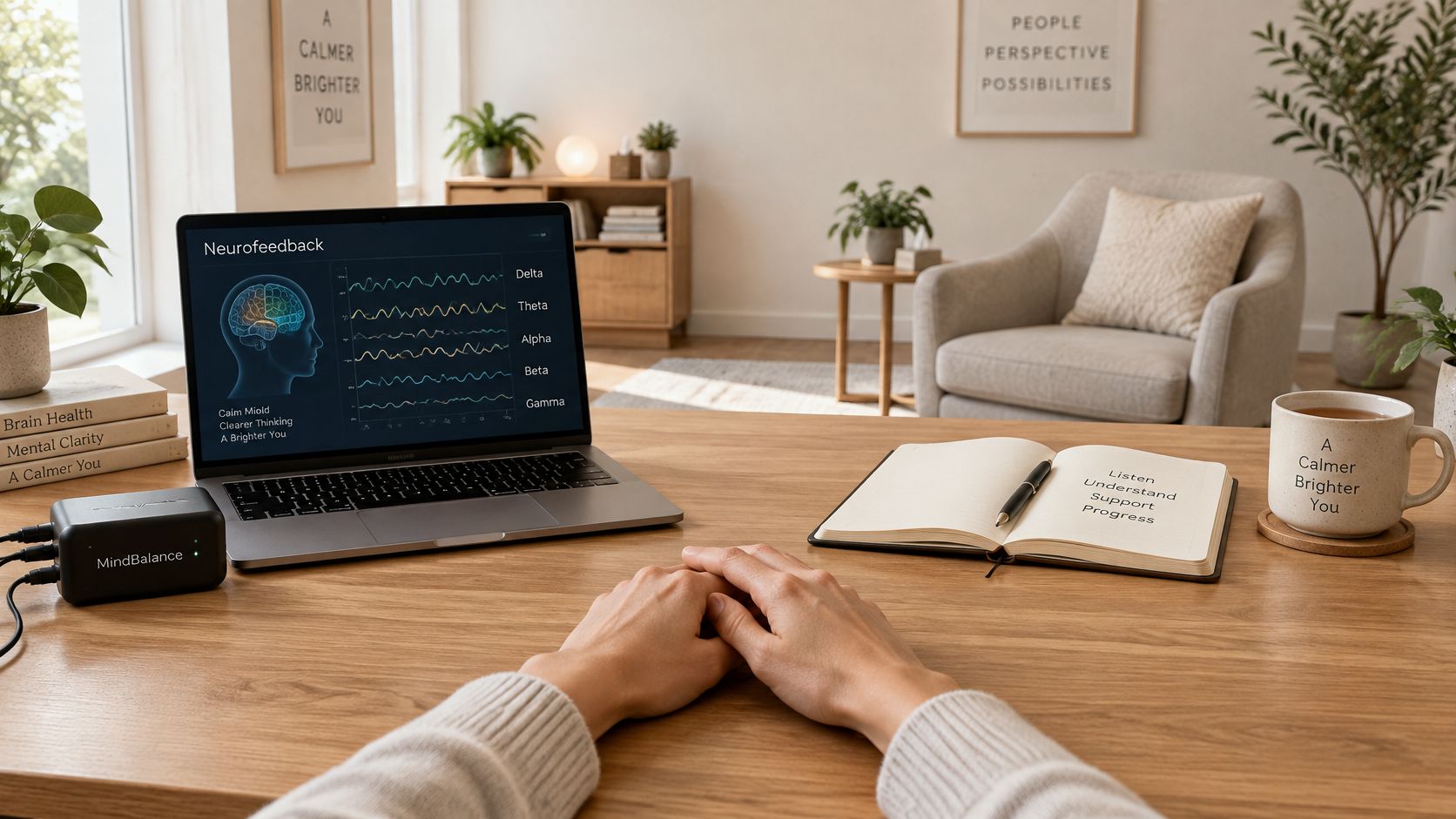
For example, a teen working on school anxiety might practice coping strategies in therapy while using neurofeedback sessions to practice regulation. Families comparing options can read talk therapy or neurofeedback for ADHD and explore the practice's counseling approaches.
Questions to Ask Before Starting
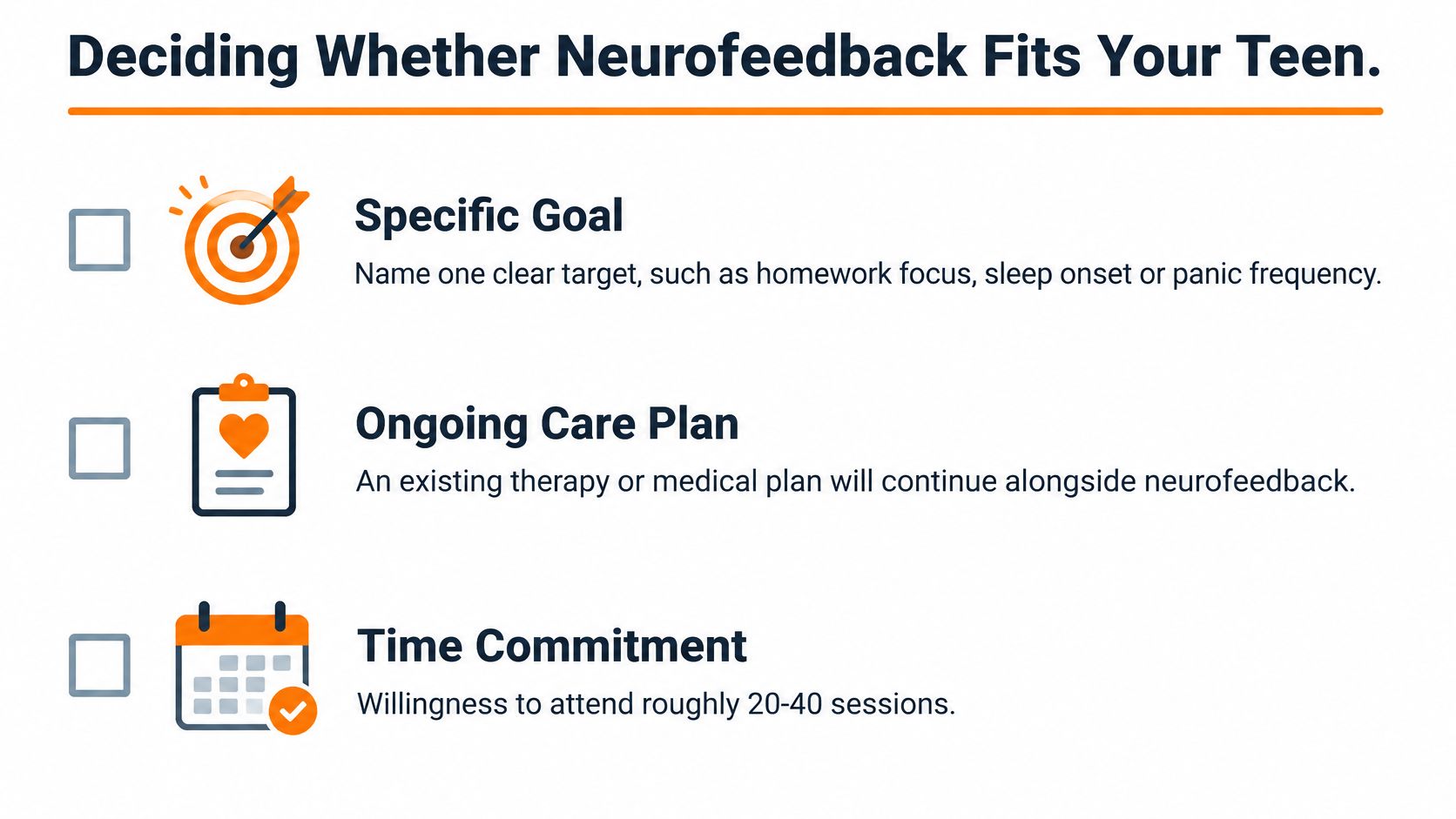
Bring a few questions to your first conversation:
What goal would we work on first?
How would you choose and explain the training protocol?
What would a typical visit feel like for my teen?
How will we check progress at home or school?
How would sessions fit alongside counseling or other current care?
For families thinking about comfort and consent during treatment, this review of ethical issues in neurofeedback offers additional reading. Your teen should have room to ask questions and describe how sessions feel.
Ask About a Neurofeedback Appointment in Katy, TX
Ready to talk about a plan for your teen? Contact Katy Teen & Family Counseling to ask about a neurofeedback appointment and share the goal you would like to work on first. You can also call or text 281-519-6364 or email info@katyteenandfamilycounseling.com. The practice is located at 23410 Grand Reserve Drive, Suite 401, Katy, TX 77494, and serves families in Katy and the greater Houston area.
About the Author

Jason Drake, LCSW, BCN-L, is the owner and lead clinician of Katy Teen & Family Counseling and a Neurofeedback Therapist Associate Fellow in Katy, Texas. Since 2003, he has worked with teens, young adults, and families navigating anxiety, depression, trauma, panic, school stress, bullying, and relationship challenges.
Jason is board certified in neurofeedback as an Associate Fellow through BCIA, trained in EMDR, and a Certified Brain Health Professional through the Amen Clinics. He also supports therapy teams and teen residential treatment centers and writes about mental health. Read more of his teen mental health articles. His media appearances include Fox 26 Houston and the podcasts Grow a Group Practice, Let's Talk With Jennifer B, and Marketing Matters. Ask about an appointment.


Comments